Generation Kool-Aid

“I was never writing to become the voice of a generation and I was never writing thinking that I was an enfant terrible. I was just writing what I wanted to write and it was other people who decided that I was or wasn’t those things. I don’t identify with either one.” –Bret Easton Ellis

“I certainly never intended to speak for anyone other than myself.” –Sally Rooney

“I think I might be the voice of my generation…or at least, a voice of a generation.” –Lena Dunham (as Hannah in Girls)

Not long after I graduated from high school (class of 1990), I became a perfect mark for books backed by a specific marketing strategy. And by this I mean books that are shilled as generational touchstones.

You know the kind of books I mean. The Great Gatsby. The Catcher in the Rye. On the Road. Infinite Jest. Prozac Nation. Anything by Halle Butler or Sally Rooney. Anything by Lena Dunham. The Fire Next Time. The Sun Also Rises. Jonathan Livingston Seagull.

That last one might seem far-fetched, even to those who’ve heard of it. An earnest, nazel-gazing little novel about, yes, a seagull, it became a best-seller in the early 70s, a time when many Americans were on a similarly earnest journey of nazel-gazing self-discovery.

Have I read it? Please. It came out in 1970, two years before I was born. By the time the book was on my radar, as a pre-teen and teen of the 80s, such late-hippie affectations had become a ruthless punchline.

By the mid-80s, a book like Jonathan Livingston Seagull might as well have been written in the Victorian Era or the Stone Age for all it spoke to readers of the new crop of books coming out. Specifically, the new crop that was being marketed to a certain kind of reader.

I was about 13 years old when Bret Easton Ellis’s debut novel Less Than Zero came out, in 1985. I have no memory of it as a book until the widely panned movie version was released a couple years later. Which was rated R so I didn’t get a taste of that either in real time.

But Ellis, who was 20 years old when he published Less Than Zero, was already being anointed the “voice of a new generation.” And he was being lumped in with a bunch of other relatively young writers who were dubbed “the Literary Brat Pack.” Jay McInerney, who had just published Bright Lights, Big City in 1984, at age 29, was one of the pack. So was Tama Janowitz, who came out with Slaves of New York in 1986, when she was about 28. Depending on your sources, Michael Chabon was also part of the Literary Brat Pack, as were Meg Wolitzer, Jill Eisenstadt, and Donna Tartt.

Decades later, the truth would come out that some of these writers barely even knew each other. Never mind the photos in such rags as Vanity Fair of what appeared to be Janowitz and Elllis and McInerney all partying together at some glamourously boozy writers’ event in NYC. In a 2016 Harper’s Bazaar article about the Literary Brat Pack, Janowitz said of Ellis and McInerney, “I didn’t know those guys. We would bump into each other at various things we had been invited to, but it was like creating a movement, as if somehow we had been hanging out together beforehand.” Ellis concurred. “I really can count on one hand the number of dinners I actually had with her.”

But for lack of another name for this “movement,” the “Literary Brat Pack” it was for any writer under age 30 who had published a novel to decent reviews between the mid-80s and early 90s.

Soon, however, there would be another name for this bunch, and for those who followed them and those who read them.

In 1989, the year I entered my senior year of high school, Newsweek magazine came out with a special issue on “The New Teens,” featuring a cover of three spunky teens, I guess, and enticing headlines like “What Makes Them Different” and “Who Are Their Heroes?” and “Advice from Judy Blume, Grace Slick, John Waters.”

Unlike Less Than Zero, I vividly remember this issue. The cover, at least. I can’t recall what was on the inside, like, who “their”–meaning my and my friends’–heroes were supposed to be. Or what advice the woman who sang “Feed your head” in the 60s could have possibly had for me. (I probably appreciated John Waters’s words of wisdom though.) I know I talked on the phone with a friend about the issue. I remember he wanted to know what I thought of the kids who were interviewed. We might have made fun of it all. Or maybe we took it seriously.

The point is that even though Newsweek was the kind of magazine your parents or school libraries subscribed to, not the kind of rag that teens willingly sought out and purchased, it got our attention.

The following year I graduated from high school. I had no idea what to do with my life, and in fact I bucked the trend at my school and didn’t go to college right away. Not even a community college. I had a vague notion of wanting to travel. To go on the very same journey of self-discovery that was promoted by books like Jonathan Livingston Seagull.

Or On the Road. Now that book, Kerouac’s book, a “voice of a generation” book from an even earlier time, I had read. And I’d loved it.

I’d also read a few likeminded books recommended to me by friends. Tom Wolfe’s The Electric Kool-Aid Acid Test. Douglas Adams’s The Hitchhiker’s Guide to the Galaxy. Tim Robbins’s Even Cowgirls Get the Blues. More books about journeys and discovery, about bucking society’s expectations in defiance of the fuddy duddies of yesterday. Only thing is, with the exception of Adams’s kooky novel, these books all belonged to yesterday, to a generation definitely not my own.

But that didn’t seem to matter to me.

Because by this time I’d also read a few of the Literary Brat Packers. McInerney’s Bright Lights, Big City and Story of My Life. Janowitz’s Slaves of New York. I wasn’t sure what to make of them. As far as I could tell, they all seemed to be about cocaine. With a little bit of Wall Street, art, and fashion thrown in. I mean, as a recent high school grad from Illinois, I could relate to stories about people who just want to jump in a car or a spaceship or DayGlo-colored school bus and zip around the country or universe with friends. But snorting lines in a toilet stall in a gallery in SoHo was completely beyond my comprehension.

I kept at it with the Literary Brat Packers though, maybe with some hope that reading the writers “of the moment” would help me figure out what it meant, if anything, to be a freshly minted adult at the end of the millennium.

So when McInerney’s Brightness Falls came out in 1992, I gave it a read. Another novel of 80s excess set in NYC, it had something to do with a brilliant and successful couple’s downfall. I recall thinking that it was a more mature work, Gatsby-like in ambition. Definitely a “statement novel.” But also totally beyond the understanding of a 20-year-old retail and food-service worker from the Midwest.

Perhaps it’s no wonder, then, that when Donna Tartt’s much-heralded debut The Secret History came out that same year, I was becoming skeptical of works by hot young writers. To some degree, Tartt’s novel might have been a tad bit closer to home. Its main characters were college kids after all. People my age at the time. But…these were rich kids at some ritzy liberal arts college out East. (Tartt, like Ellis and Eisenstadt, was a Bennington alum.) One of the book’s characters, as an elderly woman I worked with at a local library scornfully remarked, is a guy named “Bunny.” So yeah, I passed.

In the end, it didn’t matter. The days of the Literary Brat Pack were numbered.

In 1991 a Canadian author named Douglas Coupland published a novel called Generation X: Tales for an Accelerated Culture. Coupland was 29, but he wasn’t being put forth in any way as the voice of a new generation or the member of a pack. His “novel” wasn’t even that. Instead, Generation X was something of a quaint throwback to medieval works like The Canterbury Tales and The Decameron–a rather plotless collection of stories told by a group of disaffected 20s-somethings in California.

But if the premise was old, the delivery was new. For one, there was no standard 8.5 x 11 inch hardcover edition of Generation X or even a standard paperback edition. From the get-go, it was published as a rather oddly dimensioned 7.85 x 9 inch softcover book with a cloudscape stretched across the top half of the cover and a solid band of orange, green, yellow, or white across the bottom. It felt like a big floppy disk. On the inside, it resembled a zine. The margins were peppered with somewhat dispiriting facts about modern society, zeitgeisty graphics, and call-outs of terms invented by Coupland, like Successophobia and The Emperor’s New Mall and the soon-to-be-timeless McJob.

This was legitimately something new. Something that felt fresh and intriguing. Remember that Newsweek cover? What makes “the new teens” dfferent? However Newsweek answered that in 1989, the magazine probably didn’t see Coupland coming.

Nobody did. Because Coupland didn’t get the Vanity Fair treatment. Not at first. And the book was something of a word-of-mouth sensation, not the kind of novel to be featured in your local library’s book discussion group. Which was perfect for a book that came to represent a determinedly anti-brand and anti-consumerist generation.

As for the title, Coupland was inspired by a chapter in Paul Fussell’s 1983 nonfiction work, Class: A Guide Through the American Status System, a book I never even heard of. Thank the lord that someone else has. In the newsletter Culture: An Owner’s Manual, W. David Marx writes, “The final chapter of Class is called ‘The X Way Out’ where Fussell identifies an emerging group in society he calls ‘Category X’ — well-educated, Bohemian-like consumers who construct obscure lifestyles in order to transcend traditional status symbols.” Marx makes the argument that by titling his book Generation X, Coupland “decided to define his generation by its aesthetic choices — specifically, fighting the class hierarchy through the focus on cultural and subcultural capital over economic capital.”

In other words, Coupland was resisting the pigeonhole marketing of his generation, and his book, right there in the title.

Before you knew it, Ellis, Tartt, Coupland, Chabon, and even McInerney were being labeled Generation X writers. Or, at least, writers whose works and characters represented the experiences of Generation X. Never mind that the generation itself was soon defined as people born between 1965 and 1980, and several of these supposed “Gen X” writers went back to the 1950s.

It didn’t matter. There was no going back now. The term was out there, and no doubt marketing teams across the country breathed a sigh of relief. Now they could claim for their own purposes a catchy yet edgy name for the coveted youth demographic. Because just like it’s easier to communicate to a crowd contained in one area, instead of blaring from a loudspeaker pointed in all directions over open ground, it’s much easier to shill to people who’ve been wrapped up with a label.

Names are tricky things. They give things legitimacy and anchor them in meaning, but when applied to a large group of people, they reduce those people to a captive audience. And with a captive audience you can make people listen to or do almost anything.

As anyone who’s ever perused a catalog or read an astrology chart knows, the next step after labeling something is to describe it with a few punchy yet vague predictions and adjectives, the kind that can apply to anybody at any time. Ideally, the adjectives should be semi-flattering. They should hint at distinction and specialness, at some je ne sais quoi that sets this…thing…apart from all the other things before and after. You do want people to buy what you’re selling after all. If you really want to spice it up, you should also toss in some element of danger, a hint of caution, a touch of the forbidden. Not so much to set off any “buyer beware” alarm bells, but enough to stir the buyer’s curiosity.

So, if it’s a group of people you’re trying to sell and sell to–specifically, a group of people born between this year and that–you might flatter them by saying that they’re already much wiser than the people born before them. You also might tell them that nobody’s seen the troubles they’ve seen before, which is flattering in the sense that it validates their anxieties and fears, even if it is quite condescending and possibly even absurd (considering that humans have been dealing with all kinds of crap for centuries now).

To put an edgy spin on it–because young people love to walk the edge, I guess–you can rebrand their so-called preternatural wisdom as “cynicism” and their anxiety and fears as “apathy.” If that seems to lose ’em, reel ’em back in by telling them that they’re, say, “diverse,” so much more “diverse” than the people who came before them. In all the history of the world, no one has ever “diversed” as much as these “diverse” young folk have “diversed.” It’s really quite commendable.

If any of this sounds familiar to you, if it sums up you, your friends, and school chums, even for just 10 seconds of your life so far, congrats! You’ve got yourself a generation: Generation X!!!!!!

Or maybe this label is supposed to go with Millennials. Or Gen Z? Or the Lost Generation? Or Libras. Maybe Geminis. Yeah, that’s it: Gen Z Geminis with a diverse no-foam Greatest Generation moon. Maybe the label is b.s. Maybe we can make it mean whatever we want it to mean. If one generation rejects it, recycle it for the next. Young people, they like recycling.

But back to Coupland’s Generation X. It wasn’t long before Coupland found himself in the “voice of a generation” club alongside Ellis and Tartt. Meanwhile, McInerney and Janowitz kind of dropped out of the picture, while others filled the void. David Foster Wallace. Zadie Smith. Elizabeth Wurtzel. Dave Eggers. Colson Whitehead.

No surprise that Coupland rejected the label, even if he did keep writing about the pecularities of people under age 30 as if he, too, wanted to corral them into some kind of subclass. Case in point, his second novel, Shampoo Planet, came out in 1992 and centered on the younger sibling of one of the main characters in Generation X–a determinedly anti-Boomer Alex P. Keaton-style “global teen” named Tyler who at one point declares “My memories begin with Ronald Reagan.” Confusingly, Coupland defined “global teens” as “alien to X as X is to baby boomers.” Even though the “global teen” characters in Shampoo Planet belonged to the X years, as the generation would come to be defined.

That kind of confusion should have been a warning against taking generation labels too seriously. But as we stand now, in 2025, generational labeling (and bickering) has been dialed up to 11 since the days of Coupland et al.

When it came to the first books that got the Gen X label, I have to admit I drank the Kool-Aid. Generation X thrilled me when I first read it. Not that it resonated with me. Who needs resonance when you’ve got that cover! Those call-outs! That marginalia!

I remember I was especially eager to read Shampoo Planet, even if Coupland’s “global teens” comment did mystify me. His comment that the book was specifically about people under age 25 (which I was at the time) is what got me hooked.

But Shampoo Planet left me wanting. Just as with those coke-snorters in Slaves of New York, I didn’t relate to Tyler and his friends. The title, for example. It came from Tyler’s obsession with hair and grooming. That alone felt like b.s. to me. Still does, especially when you consider that this novel came out one year after grunge took over with Nirvana’s “Smells Like Teen Spirit,” another so-called generation-definer. It also followed on the heels of Ellis’s American Psycho, a extremely violent novel about a serial killer that became a bit of a rallying cry for free speech–and also centered on a young charater obsessed with grooming. For the record, Ellis did it better, had more of a point with it, knew what his targets were.

But which was it? Were we preps or were we slobs? Achievers or slackers?

I couldn’t tell you. As a reader, I removed myself from the debate. I didn’t read Zadie Smith or Donna Tartt or Bret Easton Ellis or Dave Eggers–not until much later. Forget Elizabeth Wurtzel. I thought her book covers were a joke, an obvious ploy for “controversy”–maybe not engineered by her, but still. Twice I made an attempt at Infinite Jest. Interesting writer, but I didn’t get very far either time.

Instead, I just read what I wanted to, no matter when it was written and who the book was supposed to be aimed at. I read a lot of Irish literature, including some current folks (Roddy Doyle, Pat McCabe, Colm Toibin). I read Romantic poets and classic American texts and celebrity bios and African American fiction and books by women. I fell in love with the novels of Louise Erdrich, Tayari Jones, Emer Martin, Cormac McCarthy, and Toibin. I loved Frank O’Connor. I loved Lonesome Dove and Kristin Lavransdatter, two epic masterpieces that are worlds apart in setting and style. I read more poets. I adored Shelley and Keats, Yeats, Kevin Young, Frank O’Hara, and Nuala Ni Dhomhnaill. I liked random reads like Hector Tobar’s The Last Great Road Bum and Mike Tidwell’s Bayou Farewell and Richard Rodriguez’s Darling and Fernando Pessoa’s The Book of Disquiet. The Creative Quest by Questlove. That book by Patti Smith where all she talks about is her favorite detective shows and coffee.

Sometime in my 40s I finally circled back to Generation X. By this time, people my age had long passed the expiration date on coolness and no one was putting us on magazine covers anymore asking what makes us different, partly because magazines had become about as relevant as a Richard Brautigan novel. Or Jonathan Livingston Seagull.

Gen Xers were already getting lumped in with Baby Boomers, our one-time enemies, who in turn were suddenly being burned at the stake for everything from hastening climate change to ruining Facebook. More often than not, Gen Xers were overlooked entirely. Skipped over from Boomers to Millennials. Like we weren’t there, hadn’t made so much as a dent in the culture.

Maybe all this societal change and generational name-calling stirred in me some sense of territoriality mixed with nostalgia. Because I started checking out some of the heavy hitters of my generation’s salad days. A collection of David Foster Wallace essays (pretty good…a mixed bag if anything). End of the Road. OK, that’s a movie, but a movie about Wallace. White Teeth. (Liked it.) The Goldfinch. (Started out decent then became a slog.) The Interestings. (Meh.) A Heartbreaking Work of Staggering Genius. (Ugh. Did. Not. Finish.) Less Than Zero. (I had no idea it was a Christmas story.)

Mixed in with these reads were some by the new kids. Normal People. (OK.) Beautiful World, Where Are You. (Ugh. Did. Not. Finish.) Eileen. (Not bad.) Self-Care. (Yeah, dumb.) My Year of Rest and Relaxation. (Also not bad.) The New Me. (Pretty good.) Banal Nightmare. (Also pretty good but the relentless nastiness starts to feel like “uh huh, uh huh, flips pages to move it along.” I can be convinced otherwise though.)

And yet, say I saw glimmers of myself in those books. My younger self, my current self, whatever. Say there were parts that resonated with me. Parts that made me laugh, made me feel wistful. Say there were characters who felt like people I knew. Places and scenes that felt so true I could picture them as if they were playing out right in front of me. Given that these are supposed to be “Millennial” books, and I’m no Millennial, is that a bug? Am I just imagining universality? Or is that a feature?

Maybe it’s what literature is supposed to be. And maybe it’s what humanness, no matter when you’re born and when you die and what years fall in between, is supposed to be.

In 2021 Bret Easton Ellis came out with The Shards. Ellis has become something of a cranky old man in recent years, but a cranky old man who is ride or die for his generation. No surprise then that The Shards is something of a love letter to the 1980s. Its music, its movies, its hedonism. Much like those coke-addled tomes of the Reagan era, The Shards is about people with whom I have nothing in common other than sharing the Earth around the same time in history. Much like Less Than Zero, its characters are all spoiled, amoral rich kids in Los Angeles who do a lot of drugs and have a lot of sex, always with a pool nearby. In The Shards, though, there’s a plot about a serial killer that somehow…makes you feel for these trashy teens. It’s a gripping read, but that’s not what surprised me. What surprised me is that it resonated with me. That it almost felt like, yeah, this was the 80s. This is Gen X.

It could be that nostalgia has finally primed me for the kind of marketing that accompanied Gen X novels of the 90s. That in the face of rapid change, I’m giving in to a Kool-Aid flashback and clinging to something familiar. Nodding along to the spiel, happily handing over all my money, buying the T-shirt and not even pretending anymore that I’m wearing it “ironically.”

It’s also possible that Ellis just wrote a good story. Did he write it for people like me? Or any and all takers?

Most likely the latter. It sounds dumb, after all, to propose that Fitzgerald wrote The Great Gatsby for flappers and bootleggers, with no eye on immortality. Kerouac originally modeled himself after Thomas Wolfe, a serious and conventional novelist. Then he wrote On the Road. That novel wasn’t him throwing in the towel, and it certainly wasn’t him trying to set a trend by catering to an as-yet undefined generation of rebels, beatniks, drop-outs, and seekers. The very idea is, again, dumb.

Instead, On the Road was a self-serving creative breakthrough–as all swing-for-the-fences literature should be. It’s why young people still fall in love with the book decades later. And why crabby old post-menopausal hags like me can admire and look forward to a new Halle Butler novel, as well as a new Louise Erdrich. Even a new Bret Easton Ellis.

Generations come and go. Good stories are for the ages.
The Guide to Good Apple Self-Care

Unless you’ve been living under a rock or in a hard-core Luddite community a million miles from the grasp of the internet (bliss!), you’ve probably heard about the kidney story. I won’t rehash it all here, but long story short: The New York Times ran an article recently about a dispute between two up-and-coming writers, one of whom plagiarized from the other’s Facebook posts to write a fictionalized “takedown” of the plagiarized writer’s experience as an altruistic kidney donor.

The Times article received lots of attention, with follow-up think pieces and heated Twitter convos galore about what counts as plagiarism, what personal stories an author has the right to mine from someone else’s life, classism and gatekeeping in the writing world, literary mean girls (and guys), and ableism and health privilege. The last issue may have produced the most revealing and necessary conversations. A lot of people became newly aware of the kind of marketing and networking asked of organ donors and recipients alike to save people’s lives. The promotional posting and sharing done by the plagiarized writer/kidney donor only seemed “cringe” or “narcissistic” to those lucky enough to be so ignorant of the urgent realities of organ donorship. Also, a lot of big-time writers really showed their ass.

I probably don’t need to say I’m Team Dawn on this. Also Team Anyone Who Helps Out Someone In Need of an Organ. I have family members and friends whose lived were saved by receiving an organ transplant, family who suffered terribly through years and years of dialysis, and family who risked their own health to donate an organ. They all can talk and share and post about it all they want wherever and whenever. Serious health issues will teach you there’s far worse in life than coming across as “cringe” to the cool/mean kids.

Reading about “the kidney story,” including the contested story in question (“The Kindest”), reminded me of an organ transplant story of my own, “The Guide to Good Apple Self-Care.” I wrote it in 2014 or so and got it accepted at Drunk Monkeys in 2015. It’s written from a sense of heightened, metaphorical reality (it’s about a woman who receives an apple transplant in place of a heart and her ensuing recovery). I honestly don’t remember what inspired it, but I went back to look at it to see if I approached the issue of organ transplant with any more or less respect than “The Kindest.” I thought I’d share it here on my site for anyone who follows my posts here to judge. I’d really welcome the feedback. I don’t write stories like this so much anymore–I’ve moved away a bit from metaphorical, magical stuff–so I can’t say I’d write something like this today.

The Guide to Good Apple Self-Care

The day after my heart crashed, the doctors told me they’d have to take it out and replace it with an apple. “Don’t ask why,” the head doctor told me. “You’ll never understand.” The head nurse was nicer. She patted my hand, gave me a pamphlet to read later with tips for good apple self-care. “Don’t you worry,” she said. “An apple works just as well as a heart.” The doctors concurred. “In the future we’ll all have apple transplants!” they joked, as I breathed in the anesthetic. Just before the blackness took me, I thought I heard the head doctor mutter, “Apples…or alarm clocks.”

I woke 5 hours later, with my apple installed. That was nearly two years ago—since then it’s been nothing like I thought it would be. For one I thought it would make me sweeter, having an apple for a heart. With a crisper personality, whatever that might be (I figured I’d find out). But that’s not how an apple for a heart works.

There are advantages, that’s for sure. I can take a knife to my apple and cut away the bruises, whereas with my heart I had to suffer its accumulated injuries all times and forever. I’ve a little door on my chest now, like a small square flap with a latch that I can open, so I can view my apple every day and check out the shape it’s in. And the skin I can peel away, if the blush on my apple ever gets too deep, too bold, and threatens to spread to my face and give my feelings away. Because my feelings are still centered there, in that spot beneath my left breast, more than ever I think. You see, before a heart was just the word I used to mean the emotions generated from my mind—that and the thing that crashed on me. But now it’s become more complicated. My heart is an apple. My apple has become my mind. My mind is in my chest, beneath a small flap-door…I know I’m not explaining it well.

This is what I never expected, what the experts forgot to mention in the guide to good apple self-care—the way this would mess with what I used to call “speaking from the heart.” After my transplant I wanted to be honest, and I wanted to be accurate. I wanted to know how to juggle staying true to my experience with talking about it to the curious and concerned. So I went to a therapist. “I can help you,” he said. “But it will take at least 10 sessions, at $80 a session, to get to the heart of the matter.” I found a new therapist. I found I was the problem. “Take heart!” the new therapist would say. I’d set my jaw. “Recovery is not for the faint-hearted.” It would go on like this—sometimes I’d swear I was being set up. I’d swivel my head around, look for the hidden camera. Instead the therapist’s alarm clock would go off. “Time’s up! See you next week?” I walked out after the third session without giving a yes or no, went back to my car, and sat for a while carefully cutting away my bruises.

I have had some luck, though, in the love department. I met a woman while at a St. Patrick’s Day parade who’d had a few. So I felt I could talk to her, open up about my apple. She said: “I’ve got a friend, a big cider drinker. I’d say he’d fancy you.” I laughed, thinking it was a jest at my situation, and a rare good one at that. But she was serious, and she was meeting up with him that night, so she invited me along. Well, I knew him from across the bar. He reeked of apples (I’ve developed a high sensitivity to the smell of my stand-in heart). And his face was as red as one too. You may laugh, but a connection is a connection. It was like someone had opened up the door to my apple and held a mirror up to it. I looked at him and I saw everything I’d been through since the transplant. I saw a man who’d understand.

We went out for a while, for a few months, until the leaves began to change colors on the trees. It’s funny because I was feeling such a fullness in my apple around the time it ended. The days were growing shorter, the leaves were dying on the trees and rustling to the earth, and there was a coolness coming in the wind—but I was under the impression the world was really blooming. Our love was growing, ripening, ready…I was sure my cider man felt it too. But he ended it and moved on immediately to another girl. She came from Michigan, right over the border. Her father owned an orchard. We’d gone there only a few weeks before the break-up, for our 6-month anniversary, when the McIntosh crop had just come in. It was there I told him I loved him, and where he stripped the leaves off a branch of Red Delicious and wove them into two crowns, one big, one small. “For your russet hair and your apple heart.” He met her as we were leaving, while he was paying for our bushels. I had gone ahead to the car to open the door on my chest and fit my apple with its crown. I never saw it coming. Last I heard they’d gotten hitched and were growing an orchard of their own.  I don’t like it, but I get it. Why settle for one of what you love when you can have it in bushels?

In time I got over him. I cut away my bruises, peeled away my shame, and put a lock on the latch to my apple until a new skin grew and a new year began. I kept myself busy, took on anything to ward off those feelings that I’d been eaten up and spat out, discarded like something rotten, misunderstood once again. I learned to cook, I learned to bake, I learned to garden, I learned computers. I even talked to the head nurse at the hospital where I’d got my transplant and asked if I could write a new and improved guide to good apple self-care. I found I was fit for all kinds of things—all kinds of activities, all kinds of plans and dreams.

Still I waited for some sign that I’d fully recovered. Every day I looked in on my apple, and I’d think about that time in the fall, when I felt such a fullness, such a ripening, and I wondered if I’d ever know such happiness again. The weeks went by, and I ticked off the days on my calendar seven at a time. The week of St. Patrick’s Day, I marked off the day of the parade with ink as red as the skin of a Red Delicious apple.

Then in April the head nurse left me a message. “Your guides have come in from the printer. Come in to have a look at them…and schedule your next check-up.”

I went in the next morning. The head nurse had stacked my guides on the counter where the patients sign in. She came out and placed another stack in my hand. The doctors came out too, and the staff in the waiting room and even the patients all crowded around. “Looks good!” said the head nurse, using the same tone as after she’s checked my vitals. Everyone congratulated me and took a copy, and an old man asked me to autograph his. The head doctor leaned in to me as the old man was called in by a nurse. “He’s scheduled for a transplant next week,” he said, placing a hand over his heart for a moment, before miming the act of biting into a Jonagold. I brushed off his thoughtless gesture and left with my stack of guides.

I sat in the car with them, flipped through the stack, read a copy front to back, admired the smell and visuals, and placed them all square in my lap. I stared down at them, thinking about all my effort and what I’d made. I wondered if they’d really be a help to anyone, to other apple transplant people like me. I’d never helped anyone before, never been regarded as an expert at anything in my life.

I clutched the stack to my chest and looked out my car window. I noticed a few buds on the trees and robins singing in the little park beside the health center. It was late in the afternoon but the sun was still strong and bright. The days were getting longer and spring was on its way. But it all seemed so strange to me. Because my apple was suddenly acting like it was autumn, like it was once again becoming full after so many months of waning, throbbing in the way my heart had before it crashed. I clutched my guides tighter, right against my apple. I didn’t need to open the little flap-door to see what was happening. My apple was growing. It was ripening to the red of an October sunset, shining like a skin that had never been bruised, blooming like an orchard full of brand new apple hearts. 

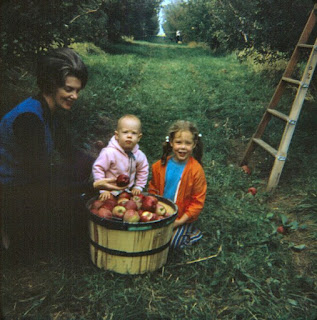
Bald baby me with Mom and my sister Arla, picking apples in the ’70s.

Selected Writings & Other Stuff

Some of my published work:

Nonfiction/Essays/Reporting

The Benefits of Taking a Writing Break (Lit Mag News)

Three new books expose the shameful history of Ireland’s Magdalene laundries (America)

Dream Paczki (Dunes Review, print only, apparently)

Is 50 Too Old to Become a Living Organ Donor? (Next Avenue)

The Tragic Testimony of the Daughters of Magdalene (Sojourners)

‘Derry Girls’ teen characters reach for peace, community and laughs (National Catholic Reporter)

What good is hell in the afterlife? Living through a global plague is hellish enough (National Catholic Reporter)

Bread Pudding for Dimitra Xidous (Poetry Potluck)

Island in the City (Substack) A (bi)monthly newsletter about outsider art, Chicago, creativity, oddballs, islands, and other interesting stuff

Bakery Girl (Medium)

Community cooks (U.S. Catholic)

Meet St. Gertrude, cat lady of the Catholic Church (U.S. Catholic)

How Chicago’s Graceland Cemetery Built a Prairie and Lost My Ancestors (Medium)

A pilgrim’s pace (U.S. Catholic)

Mixed Messages (Memoir Mixtapes)

Song recommendations (short memoir pieces) at Memoir Mixtapes:
White Mystery’s “Birthday”
Van Morrison’s “Purple Heather”
Kermit the Frog’s “Rainbow Connection”
Al Green’s “Belle”
The Gap Band’s “Party Train”

Maintaining Self-Esteem and Motivation in a Year of Rejection (Brevity blog)

The Unbeautiful Ones (Tiny Donkey) Editor’s Note; Tiny Donkey’s site has been taken down, so anything I published there I’ve republished on my site

Ancestral Hunger Pangs (Tiny Donkey) Editor’s Note

Modern-Day Mike Finks (Tiny Donkey) Editor’s Note

Writing Anxiety and the Wisdom of Improvisation (The Masters Review blog)

Lady Folk (Tiny Donkey: Brief Essays from Fairyland) 2nd-place winner in “Once Upon a Cartographer” contest

Dad’s Honor Flight: A Father’s Second Homecoming from the Korean War (Medium)

All Apocalypses, Bitter and Sweet (Literary Orphans) LO’s non-fiction Tavern Lantern site is no longer, so I’ve included the essay on my site here

New Mexico: Freedom on the Ground (We Said Go Travel)

Walking with the World on the Camino de Santiago (Encyclopaedia Britannica) Republished at Camino Ways

Women of Ireland (Encyclopaedia Britannica) More of my Britannica blog articles are available at this link

Walking to the Well (AranIsland.info)

Island Luck (AranIsland.info)

Writing and Wayfaring (personal travel blog)

Fiction:

The Widow’s Quilt (Medium)

Year of Conor McGregor (Hobart)

Bad Babysitter (Cease, Cows) Nominated for The Best Small Fictions 2018

The Guide to Good Apple Self-Care (Drunk Monkeys)

Chicago Rides For Michael Jackson (here, with author’s note)

Poetry:

Putting on Eyeliner with PTSD (Awakened Voices) Republished at Memoir Magazine

The Buffalo Return to Illinois (Rose Red Review) Another defunct journal, so I’ve republished poem on my site

Periphery (Thank You For Swallowing) Based on Edward Hopper’s 1939 painting New York Movie

The Subject and the Stranger (Ekphrastic: writing and art on art and writing)

Bioluminescent Bay, Aisling, and Coconut (The Writing Disorder)

Transference (Middle West) (Eunoia Review)

Golden Day (Literary Orphans)

The Fading of the Heart and Australia (Wilderness House Literary Review)

Interviews:

Interview with Jamie Kralovec, urban planner (U.S. Catholic)

Interview with Samantha Power, activist, author, and former U.S. ambassador to the U.N. (U.S. Catholic)

Interview with Louise Erdrich, novelist (U.S. Catholic)

Interview with Timothy Egan, journalist (U.S. Catholic)

Interview with Nuala Ní Dhomhnaill, poet (Tiny Donkey)

Interview with Kelly Vivanco, artist (Tiny Donkey)

Interview with Ram Devineni, filmmaker and comic book creator (Priya’s Shakti) (Tiny Donkey)

Reviews:

Once Upon a Time in Northern Ireland (National Catholic Reporter)

Derry Girls (National Catholic Reporter)

Ireland and the Magdalene Laundries by Justice for Magdalenes Research (National Catholic Reporter)

To Hell with It by Dinty Moore (National Catholic Reporter)

The Best Catholics in the World by Derek Scally (America magazine)

In the Event of Contact by Ethel Rohan (U.S. Catholic mag)

10 books young readers will love this Christmas (Christmas, Advent, and new children’s books roundup for winter 2020; U.S. Catholic mag)

Postcolonial Love Poem by Natalie Diaz (U.S. Catholic mag)

Lost, Found, Remembered by Lyra McKee (U.S. Catholic mag)

In The Field Between Us by Molly McCully Brown and Susannah Nevison (U.S. Catholic mag)

Book of the Little Axe by Lauren Francis-Sharma (U.S. Catholic mag)

Places I’ve Taken My Body by Molly McCully Brown (U.S. Catholic mag)

Other:

Encyclopaedia Britannica articles: Contributor of articles in Britannica’s core database on the topics of witching hour, Irish Travellers, Claddagh ring, urban legend, neo-noir, femme fatale, Midsummer, Mar-a-Lago, wendigo, nepotism, Oseberg ship and more.

The Dangerous Divide (Library Philosophy and Practice): This is an academic paper I published about how libraries are closing the gap in the digital divide for older adults, particularly during the COVID-19 pandemic when lack of access to the internet has had deadly consequences for this population. This was a final project for an MLIS course taught by Bill Crowley at Dominican University.

Tales of Old: A digital resource and annotated bibliography of representations of older women in folk and fairy tales. This was created for an MLIS course taught by Janice Del Negro at Dominican University.

Played the role of Marcy, the art school prof, in TV pilot The Artists

Photo: Coumeenole Beach, Ireland (Rockwell’s Camera Phone)

Photo: Untitled (Rockwell’s Camera Phone)

Year of Conor McGregor

So here’s a short story I wrote a few years ago and got published at Hobart, which was a tremendous honor. To top it off, the editors paired it with some terrific art by Barrelhouse artist Killian Czuba. This piece is fiction and the narrator and her family, etc., aren’t me and mine. I’ve never even watched a boxing or MMA match. I wrote it as a kinda/sorta tongue-in-cheek yet loving take on Irish-American identity. I’m sharing it again now because it’s also a “worker’s story” and this is Labor Day weekend. Whoever reads it, if you’re suffering through a similar situation as the narrator, hang in there and don’t give up: There’s going to be a clear road.

I’ve always been the one you wouldn’t want to back in a match of wills. I work in an office. I’m a woman, a little overweight, unmarried. I live with my dad. He looks after me and I look after him.

My boss is a man, more than fifteen years younger than me, and his boss is a woman the same age as him.

Recently, for my yearly review, my boss noted how much my confidence had increased in composing emails. He said he noticed this increased confidence in the tone of quite a few of my messages, all of which I’m required to cc him on, and he wanted me to know how much he appreciated my efforts and recognized my growth. I did not tell him I’d been writing emails since well before he joined the workforce or that I sent my first one before he was even born. And when he suggested I continue my growth and skill variation in the year ahead by taking a social media for beginners course, I did not remind him I had taken it already at his and his boss’ suggestion after my previous review.

He forgets things often: assignments, deadlines, approval of my overtime pay. “I forgot,” he says, while giving me a project on Wednesday that had to be done Tuesday and came to him for assigning at least a week ago. “Sorry,” he doesn’t say. Instead: “You need to have this done before lunch today, no later than 1:00. You can work through lunch if you need to. Don’t worry if you have to go over your hours and stay late to finish the rest of your work. I’m okay with that.”

The other men at work treat me with respect or just ignore me, which I’ve been told for women like me means almost the same thing. Except one, who’s begun to make a particular noise whenever he sees me coming to make the guys in the cubicles around him laugh. He’s a temp, I’m told, when I speak to my boss’ boss about it. Or a consultant. It’s hard to know which, since my boss’ boss changes her mind on his title, on everything, hourly. In any case: “He won’t be here much longer…maybe. Don’t worry about it.”

My dad is a widower and retired. He worked a machine in a plastics factory for his life’s occupation. These days he watches sports and politics, bitches about the Republicans, reads the newspaper every day (he still gets it delivered) and every book he can find about the wild west and the American Indians. He admires their spirit, he says, their defiance. Dad always did respect a fighter. His favorite sport is boxing. On his left forearm, he has a faded tattoo of an Irish flag, the colors long blurred by patches of wiry old man’s hair and the purple, brown, and deep blue spots of age. Dad prides his Irish heritage. His “Irish blood” as he says, though there are several kinds of blood coursing through him. Irish, Welsh, German, possibly a little Czech. But Dad favors the Irish strand over all. The Irish, Dad says, have been in a state of active resistance for over 800 years. Unconquerable, he calls them. “Them” including him, me, and most of all Mom – “the full Irish breakfast” as Dad used to call her, teasingly but with respect bordering on adulation. She was the real deal after all, her parents Belfast born and bred.

She was not a naturally pretty woman. I took after her in that regard. She had a broad back and shoulders and pale eyelashes that made her look like a rabbit when they were bare, which wasn’t often. Mom always wore makeup. And dresses or skirts, never slacks – though dungarees, as she called them, were an occasional self-treat. Thick high heels, even while waitressing at the diner all day. And scads of jewelry, even though her employer threatened to fire her for it day after day. She favored quirky, dangly earrings and unique, colorful brooches – and of course, her wedding ring, an uncharacteristically simple, slim-band item that Dad wears now, on a chain around his neck under his shirt.

Mom’s most prominent feature was one I gratefully missed out on, a strong jutting jaw, like an old-time boxer or one of those tough street kids in the black-and-white Bogart movies. Mom was a toughie herself. If I got bullied at school, she’d come up with the nastiest insults you ever heard to trade back with my bullies. She would’ve gone and said them straight to the mean kids’ faces, and to their parents, my teachers, the school principal, the whole world within her aim and earshot if Dad hadn’t time and again stopped her. Mom was the kind who always needed to be moving, working, acting on something, whether a cause or an impulse, or a real or imagined slight or barely healed pain. She wouldn’t have lasted long at my workplace. The sitting in a cube all day would’ve driven her nuts. And my boss and his boss, and the “consultant”? I’d give anything to bring Mom back just to see how they’d fare against the likes of her.

Though she passed away nearly fifteen years ago, Dad talks about her, champions her every deed and accomplishment as if she’s still here – alive, well, and above all, willful. “Your mother was quite a woman,” he’s always telling me, as if it needs reminding, as if I or anyone could ever forget her or compare. 

In my cubicle at work I keep a small picture of her. It’s the only personal item I keep. I used to have colorful calendars, inspirational quotes, even a little plant back in my first few years at the company, but I took it all down in the past couple years, a few months after my current boss came on. I keep Mom’s photo propped up by my mouse, close at hand. Easy to take on the day it comes to that.

It’s true I do a lot of overtime, more than I should be willing to, but it’s not out of any loyalty or dedication to my work. I use my overtime pay on Dad, always keeping my ears perked up for him to mention something he would love to have or do. Like this year for his birthday, I gave Dad the gift of a fight. The Mayweather vs. McGregor match on pay-per-view. Dad couldn’t stop talking about it for weeks. It was Mayweather this and McGregor that. Who was he rooting for, I asked, thinking that was a no-brainer. Dad has always been something of a purist when it comes to boxing – he used to say boxing was for athletes, mixed martial arts was for animals. And besides, did anyone really believe McGregor, even with his mountain’s worth of confidence, could hold his own at boxing with, as Dad called Mayweather, the greatest pound-for-pound fighter to wear a pair of gloves since Ali?

By way of answering me, Dad reached into the back pocket of his trousers, pulled out his wallet, and fished out the few bills inside. “That’s on Mayweather,” he said. “What about your kinsman?” I said, teasing. “What about your fighting Irish pride?” Dad placed his hand on his heart. He took a moment to rub at something on his chest, and I knew it was the ridge of Mom’s wedding ring protruding through his undershirt. Then he lightly thumped his chest, his heart, the ring, all of it, as if for luck, and said, “This is on McGregor.”

The day of the match Dad got a barbershop haircut and shave, put on a clean old dress shirt of his, and suggested we order Chinese for dinner and eat it on proper plates with Mom’s silverware. “Some people got the Superbowl, I got the fights,” he said when I took note of his newfound dapperness. Maybe a secret memo had gone out. Just before the fight a picture went viral of McGregor getting his hands wrapped while wearing a three-piece designer suit and shades. I showed the picture to Dad on my phone. “Look at him,” I said. “Full-time flamboyance this guy has.” Dad corrected me: “No, Jean. Fighting form. Battle gear.”

Once the fight started, Dad burrowed into a respectful silence. It’s something I’ve always appreciated about him, that he doesn’t act out fights vicariously like so many other male fans. No shouting at the screen, no balling his hands into fists and jerking his shoulders as if shadowboxing his diminishing potency in his Lazy Boy. Dad watches a fight as if it was a mass, an almost mystical occasion whose noisy embellishments and flashy sideshows are only included for the benefit of those who don’t understand the stakes and significance of a fight the way he does. Which isn’t a conceit. Dad’s a Depression baby, a war draftee, a factory lifer. And yeah, Irish – 800 years of resistance, fighting form, and all.

But McGregor lost, after all that hype and hope. Dad applauded anyway when the match ended and got out a bottle of discount brandy for a birthday toast. He poured a glass for me and we both stood in the kitchen drinking. “Did you enjoy the fight, Jean? It was a good one, wasn’t it?” he said. “But our guy lost,” I said. I downed the brandy in one gulp, feeling thirstier and edgier than I could remember. Dad laughed and passed me the brandy bottle. “He lasted 10 rounds, Jean. Against Mayweather. That’s the important thing.” He put his empty glass in the sink. “There’s winning and losing, and then there’s fighting. The first two are just outcomes. The third is something else altogether. A way of life. A fighter doesn’t always need to win or lose to justify himself or prove his worth, Jean. He just needs to put up a good fight. Make a good stand.” He moved to the doorway of the kitchen. “This is just the beginning for our man McGregor. You watch.” He winked and thanked me for his birthday gift, then went off to bed. But I stayed up.

I am not like my parents. Not on the inside. Like I’ve never been comfortable with confrontation. Though there’s beauty in a fight that even I can recognize, I’m never at the ready with a withering comeback like Mom always was and I don’t have the ease with handling confrontation, the philosophical attitude about it that Dad does. That night, after the fight, I stayed up in the kitchen wondering where it all went wrong with me. Perhaps the Irish in me is too watered down, too commingled, beyond Dad’s even, beyond the brink of any inborn courage and inherited resistance. Perhaps the fighter’s gene, if there is one, skips a generation.

Dad always says Mom worshipped me, her only child. Whenever I’m feeling low about my job, he says she would be proud to know I escaped working class life, that I have a “nice clean job” in an office instead of working on my feet or at a dangerous machine all day like they did. Something stable too. He may think that and I get it, I really do, but I don’t feel it. Certainly not when I walk past the consultant’s desk and hear his juvenile joking and his cubicle neighbors’ cowardly giggles, and all I do is walk on red in the face without a word in defense of myself. And not when I put away my resignation letter for yet another day or get denied a raise for “budget reasons” for yet another year or see the boss and his boss going out with the consultant for lunch more and more often, my boss’ boss laughing and blushing as the consultant opens the door for her, and all of them acting sweet as Halloween candy swiped out of some scaredy-cat kid’s bag.

Long after the match, I kept the picture of Conor McGregor getting his hands wrapped on my phone. I looked at it every day, sneaking peeks in my cubicle, in the ladies room at work, during lunch. Studying it, studying him. His pose, his style, the way he held out his hands to his trainers – casually, but with undeniable power radiating from his hands, from the picture, from some mysterious realm I’ve never been able to find the door to, where self-assurance is as second nature as brushing your hair or buttoning your shirt, as easy to carry around and show off as a flashy new watch or necklace or tattoo, or a family trait. Imagine if McGregor were a woman, I’d wonder throughout the day, as I sifted through the barrage of emails from my boss, all his reminders to cc him the next time I sent this or that, the notifications that he’d be leaving early again as I stayed late. Imagine McGregor in an office. Imagine him…or her, aged a bit past her prime. How would she prep for a fight? What would it be like to be a woman like her?

More often I forget McGregor and the all the cubicle walls around me, and I picture clear roads. Just that, plain and simple. I close my eyes and imagine a twister-wrecked field, a traffic-jammed crossroads, the faces in my office crowded together into an ugly clump of eyes and nostrils and teeth, then say to myself in quietude: “There’s going be a clear road. It’s inevitable.” And there, in my mind and heart, it appears.

For the first time in a long time, maybe ever, I can feel something coming up in me, something stirring in my blood. Like I might be my father’s daughter after all. My mother’s too.

There’s one more way I take after her. I may spend a lot of my overtime pay on Dad, but for myself I splurge on makeup. Unlike Mom, I can take or leave a nice outfit, designer clothes, accessories, bling and all that. But like her, like a warrior without a shield, like a knight without armor, without makeup I feel naked. Defenseless even, like someone without a name or history or kin. I wear it every day, even when I have nowhere to go. What I’ve always loved best is a dramatic look – dark eyes, carved cheekbones, a strong mouth in a bold color. But it’s too much for the everyday, for the office, so I keep that look just for practice, just for myself.

But lately, as I get ready for work every morning, I’ve been playing up the drama, piling on the boldness, keeping a few images in mind. As I trace the shape of my eye with liner and gloss my lips, I think of the consultant and the cubicle gigglers. I’ve begun to notice, they all dress alike, eat alike, laugh alike, as if on cue or autopilot. They make a drab little blot in the center of the office, their laughter and very breath a feeble, fading heartbeat, the mewings of a nest of mice in a python’s chokehold. Their time’s up. They’re done. I apply color to my cheeks and I pick something rosy – against drabness, I say.

As I blacken my lashes, I think of my boss in a meeting room going over my annual review, clicking his pen and reading from a sheet the goals he’s decided on for me for the year ahead. The social media course. The emails. My boss’ boss interrupting me, correcting my just fine English and exchanging my just fine words for ones that make no better difference. This is the best they can do, and it isn’t much. It’s over for them too. It’s inevitable. I say it again: There’s going to be a clear road.

Second to last, I think of Conor McGregor getting his hands wrapped in a three-piece suit. Dad’s faded Irish flag tattoo and special occasion dress shirt. Mom’s picture beside my mousepad, waiting, ready.

I accentuate the angle of my brows, my cheekbones, and work my way down to my jawline, playing up the feature I’ve always tried to hide. My mother’s boxer’s jaw, jutting out from her face, from 800 years of resistance, from my long-awaiting destiny, like a fist.

Selected Writings

A selection of my published pieces…

Nonfiction:

How St. Gertrude of Nivelles became the cat lady of the Catholic Church (U.S. Catholic)

How Chicago’s Graceland Cemetery Built a Prairie and Lost My Ancestors (Medium)

A pilgrim’s pace (or How I found healing on the Camino de Santiago) (U.S. Catholic)

Mixed Messages (Memoir Mixtapes)

Song recommendations (short memoir pieces) at Memoir Mixtapes:
White Mystery’s “Birthday”
Van Morrison’s “Purple Heather”
Kermit the Frog’s “Rainbow Connection”
Al Green’s “Belle”
The Gap Band’s “Party Train”

Maintaining Self-Esteem and Motivation in a Year of Rejection (Brevity blog)

The Unbeautiful Ones (Tiny Donkey) Editor’s Note

Ancestral Hunger Pangs (Tiny Donkey) Editor’s Note

Modern-Day Mike Finks (Tiny Donkey) Editor’s Note

Writing Anxiety and the Wisdom of Improvisation (The Masters Review blog)

Lady Folk (Tiny Donkey: Brief Essays from Fairyland) 2nd-place winner in “Once Upon a  Cartographer” contest

Dad’s Honor Flight: A Father’s Second Homecoming from the Korean War (Medium)

All Apocalypses, Bitter and Sweet (Literary Orphans) LO’s Tavern Lantern site has been hacked; until it’s fixed, check out my masthead for link to this piece

New Mexico: Freedom on the Ground (We Said Go Travel)

Walking with the World on the Camino de Santiago (Encyclopaedia Britannica) Republished at Camino Ways

Women of Ireland (Encyclopaedia Britannica) More of my Britannica blog articles are available at this link.

Walking to the Well (AranIsland.info)

Island Luck (AranIsland.info) Since their blog seems to be down these days, I’ve reposted this here.

Booma “Daily Spot” entries: These are short “bookmapping” pieces I contributed to Booma: The Bookmapping Project on the places mentioned in works by Carl Sandburg, Louise Erdrich, Toni Morrison, J.M. Synge, Frank O’Hara, and Wendell Berry. A lot of good stuff by a number of different educators and writers at this site — check it out.

Writing and Wayfaring (personal blog)

Fiction:

The Widow’s Quilt (Medium)

Year of Conor McGregor (Hobart)

Bad Babysitter (Cease, Cows) Nominated for The Best Small Fictions 2018

The Guide to Good Apple Self-Care (Drunk Monkeys)

Chicago Rides For Michael Jackson (here, with author’s note)

Poetry:

Putting on Eyeliner with PTSD (Awakened Voices) Republished at Memoir Magazine

The Buffalo Return to Illinois (Rose Red Review)

Periphery (Thank You For Swallowing) Based on Edward Hopper’s 1939 painting New York Movie

The Subject and the Stranger (Ekphrastic: writing and art on art and writing)

Bioluminescent Bay, Aisling, and Coconut(The Writing Disorder)

Transference (Middle West) (Eunoia Review)

Golden Day (Literary Orphans)

The Fading of the Heart and Australia (Wilderness House Literary Review)

Interviews:

Interview with Nuala Ní Dhomhnaill, poet (Tiny Donkey)

Interview with Kelly Vivanco, artist (Tiny Donkey)

Interview with Ram Devineni, filmmaker and comic book creator (Priya’s Shakti) (Tiny Donkey)

Other:

Editor at Tiny Donkey, October 2016-October 2017

Volunteer fiction/nonfiction submission reader for The Masters Review, January 2016-September 2016

Played the role of Marcy, the art school prof, in TV pilot “The Artists

Photo: Coumeenole Beach, Ireland (Rockwell’s Camera Phone)

Photo: Untitled (Rockwell’s Camera Phone)

Selected Writings

A selection of my published pieces…

Poetry:

The Subject and the Stranger (Ekphrastic: writing and art on art and writing)

Bioluminescent Bay, Aisling, and Coconut  (The Writing Disorder)

Transference (Middle West) (Eunoia Review)

Golden Day (Literary Orphans)

The Fading of the Heart and Australia (Wilderness House Literary Review)

Fiction:

The Guide to Good Apple Self-Care (Drunk Monkeys)

Nonfiction:

Lady Folk forthcoming (Tiny Donkey: Brief Essays from Fairyland)

All Apocalypses, Bitter and Sweet (Literary Orphans)

New Mexico: Freedom on the Ground (We Said Go Travel)

Walking with the World on the Camino de Santiago (Encyclopaedia Britannica)

Women of Ireland (Encyclopaedia Britannica)

Louise Erdrich “Daily Spot” entry (Booma: The Bookmapping Project)

Frank O’Hara “Daily Spot” entry (Booma: The Bookmapping Project)

Walking to the Well (AranIsland.info)

Other:

Played the role of Marcy, the art school prof, in TV pilot “The Artists

A complete list of my credits can be found here. You can also follow me on Facebook.