Dream Paczki

Something I published in Dunes Review a year or so ago.

Day one ends in plain exhaustion, day two in a frenetic dream. As if having the smell of them all over me isn’t enough, or their crumbs lodged beneath my fingernails, I have to see them in my sleep. Before sleep, even, just by sitting down during a shift break and closing my eyes. Moving relentlessly behind my eyelids like newspapers on a conveyor belt in an old-time movie montage. Hands grabbing at them to put them in boxes and more boxes. Hands nicked with papercuts, and red and chapped from constant washing. The phone rings nonstop for orders we can barely keep up with, the register for purchases, the receipt roll at the shift changeover runs a mile long. At night it takes ages to stop hearing echoes, the voices of customers and my co-workers calling numbers, rattling off flavors. I dream paczki. And each morning I feel as if I’m waking to the eerie silence before a tornado’s touchdown.

Mid-pandemic I took a side job, a clerk in the storefront of a local bakery. It was only part-time but it felt as familiar as something you do all the time. Me and the work went way back to when I was 20 years old and taking cooking classes at a community college, paying every cent of my tuition with my minimum-wage earnings.

Like most essential workers—something nobody thought to designate us retail and bakery grunts back then—I worked weekends and holidays, up with the chickens even on mornings when I’d been out all night. At 20, I still kept hours like that, could handle being on my feet, running back and forth from register to customer, carrying heavy cakes, making it through a shift on just a few minutes’ break or a few winks of sleep.

Right away I discovered food service work was nothing like it was portrayed on shows like Friends, or in a culinary culture increasingly oriented toward the “foodie,” a still-newish word not so liberally appropriated back then. Media chefs seemed to get their pick of days off, got to travel the world, enjoy fame and fortune, rub shoulders with rock stars, were considered rock stars themselves. It was a world away from my community college cooking classes and bakery job. In the real world, food workers are chained to weekends and holidays. Thanksgiving, Christmas, Easter, graduations and First Communions, Mother’s Day sweet tables, June weddings, Memorial Day picnics, all occasions that kept us on the run from fall through spring.

But our busiest time of year was pre-Lent, when the bakery sold paczki. Polish donuts filled with fruit, cream, or mousse, then glazed or dusted with powdered sugar to rich perfection. Where I live, just outside Chicago, people live for the paczki. In the week before Ash Wednesday, they’d tell us as much more than a baker’s dozen times a day. Would even stand in line for hours for them, enduring the wait for something that came around only once a year, whereas we workers never stopped running.

Paczki time was festive as it was frenzied. Something of a party, with the desperate feel of last calls or last chances. As the saying goes, “Eat, drink, and be merry, for tomorrow we may die.” One worker would dress up as a giant paczki and pass out samples. We’d wear Mardi Gras beads, hang banners with bright colors and cartoon donuts across the storefront windows. Customers would occasionally break out in cheers when their ticket number was called. A local news crew might show up, the reporter would weave through the crowd, ask each customer their favorite flavor, how long they’d been waiting, and was it worth it? (Strawberries and whip cream, over an hour, and oh yes. Yesiree.)

Nothing about it was meant to be ironic. In the working-class heartland, food is far too complex for irony. Food is fuel, comfort, love. A family bond, through handed-down recipes or inherited eating habits. An occasion for wholesome fun, like Christmas cookie exchanges, or one for heartfelt compassion, like a neighbor’s dish of funeral potatoes. Paczki, invented to use up all the fat and sugar in the cupboard before the religious fasting season begins, bear the additional weight of Catholic guilt and the sinfulness of waste. And for bakery grunts, they bear the weight of labor.

To call something “essential” is to suggest it’s eternal. Trends come and go, technology changes, but our needs and the labor and actions we undertake to satisfy them are universal and constant. Without the essential, time would stop. Life for all would end. Eat, drink, and be merry, for real.

As for essential workers, we know we’re essential, that the world depends on us for sustenance, for healing, for the clothes on our backs, and for our daily bread. But it’s the difference between knowing it and feeling it that essential workers have to reckon with when they punch out, between a new term that gets tossed around in headlines and the day-to-day treatment you’re given on the job.

Back at the bakery, thirty years on, sometimes I felt essential. Needed. Appreciated. But most times I felt like a human treadmill, a mere vehicle for a force beyond my control.

Donning my work apron seemed like old times, and yet so much had changed. An online shop took a load off the madness of phone and in-store orders. The register’s punch buttons were now a computerized touchscreen, with excruciatingly small print for my 50-year-old eyes. The variety of paczki had expanded to a menu of 30-plus flavors, from red velvet to “Elvis” (bananas with maple custard and bacon). Faves were counted by numbers sold and TikTok polls.

The other stuff wasn’t selling as well—bread, coffee cakes, muffins, regular ol’ donuts. Not with offices closed, remote work in full force, and funerals banned or kept to private services with the bare minimum of mourners. We were perpetually short-staffed. No one wants to face crowds during a pandemic. No one wants to wear masks for hours of a shift. No one wants to risk their life for retail—not for under $15 an hour. No one but the grunts, the essential.

The day before Ash Wednesday, the last call for paczki, my state lifted its masks in public mandate. We workers kept ours on at all times, but you could see relief in the eyes and smiles of customers who went maskless as they stood in line for paczki. Still, my fellow grunts noted how strangely quiet the crowd was, almost like a herd of sleeping cows, none of the “laissez les bon temps rouler” of years past, long before the pandemic. Maybe it was that difference between knowing and feeling again. Was the pandemic really over? Could we truly breathe easy again? Would things go back to “normal” or shift to a kinder, fairer society? Which one were we supposed to want? Productivity, after all, is a hard drug to wean yourself from. No matter how happy you are to see the system take a hit, how long you’ve been dreaming to step off the treadmill, to throw a wrench in it yourself.

Many years ago, when the wife of a world-famous rock star died, a story went around about how he nurtured her through her last moments with a whispered memory vision of her favorite things. Her horse. Spring weather. Woods. Bluebells. A blue sky. During the lockdown days of the pandemic, I thought about that story more than once. In a time of daily mass death counts, maybe it simply struck me as the model of a good end.

It didn’t take Covid-19 or a job as an essential worker to learn I don’t want to work myself to death. That I don’t want my life to come down to filling orders, fearing crowds, washing my hands to rawness, running my feet off, worrying myself to sleep, dreaming an assembly line of paczki. Hoping for a better life is instinctual, essential, and that kind of thing originates in the heart and soul long before anyone learns about capitalism, productivity, irony, foodieism, or rock star treatment.

Eat, drink, and be merry. Tomorrow may be better.
Forgotten Cookies

I wrote a short article for a religious mag about my mother’s old church cookbook collection. It’s also about trying to keep a sense of community and celebrate Christmas this year while so many of us are separated from our families due to the pandemic. You can read the article here (note: I didn’t write that headline).

I enjoyed writing this piece. It brought back some sorely needed fun memories.

I used to be in the business of cooking and cookbooks. After graduating from high school, I enrolled in a culinary arts program at a community college. Our textbooks were about 4 inches thick with technical instructions for working with and repairing industrial kitchen equipment and recipes that yielded much higher quantities than in the average coffee table cookbook.

After cooking school, I found a job as an assistant cookbook editor at a publishing company just outside Chicago. The cookbooks were the kind sold in catalogs or found in the bargain books section of chain bookstores. They relied heavily on brand name products, and there were all sorts of rules about which brand’s recipes could run on the same page with another’s and how to order the list of ingredients and what made a particular ingredient “index worthy.”

I remember attending photo sessions where a professional photographer and food stylist set up shots of perfectly sized cookies with just the right number of stray crumbs and an impossibly frothy glass of milk in the background. (The froth was created by mixing liquid soap into the milk.)

I remember other cookbook editor tricks like the time we came up short for recipes for a slow cooker cookbook (we didn’t have the licensing to use the term “Crock Pot”) that was supposed to feature recipes submitted by “real” home cooks across America. We resolved the problem by pulling recipes from our database and making up names to go with them using the editors’ pets’ first names combined with the married editors’ maiden names followed by some random town.

Out of the whole mix, we had to pick a winner from the recipes by actual home cooks and run a special “spotlight” with a picture of the winner in their home kitchen and a mini-interview. As this was my first publishing job, I wholeheartedly believed someone on staff had tested the recipes to choose the best one. My boss had to break it to me that what we picked was the recipe by the closest cook, not necessarily the best one. “What, you think it’s just a coincidence the winner lives in Gurnee?” she said.

Apart from my professional cookbook experience, I’ve worked off and on in a local family-run bakery going back to before my culinary arts degree days. A real old school kind of place. A lot of the cake and pastry decoration ideas came from Pinterest and Cake Boss, but the recipes were the genuine passed down from generation to generation variety. They were kept in a battered black book that was locked in a safe.

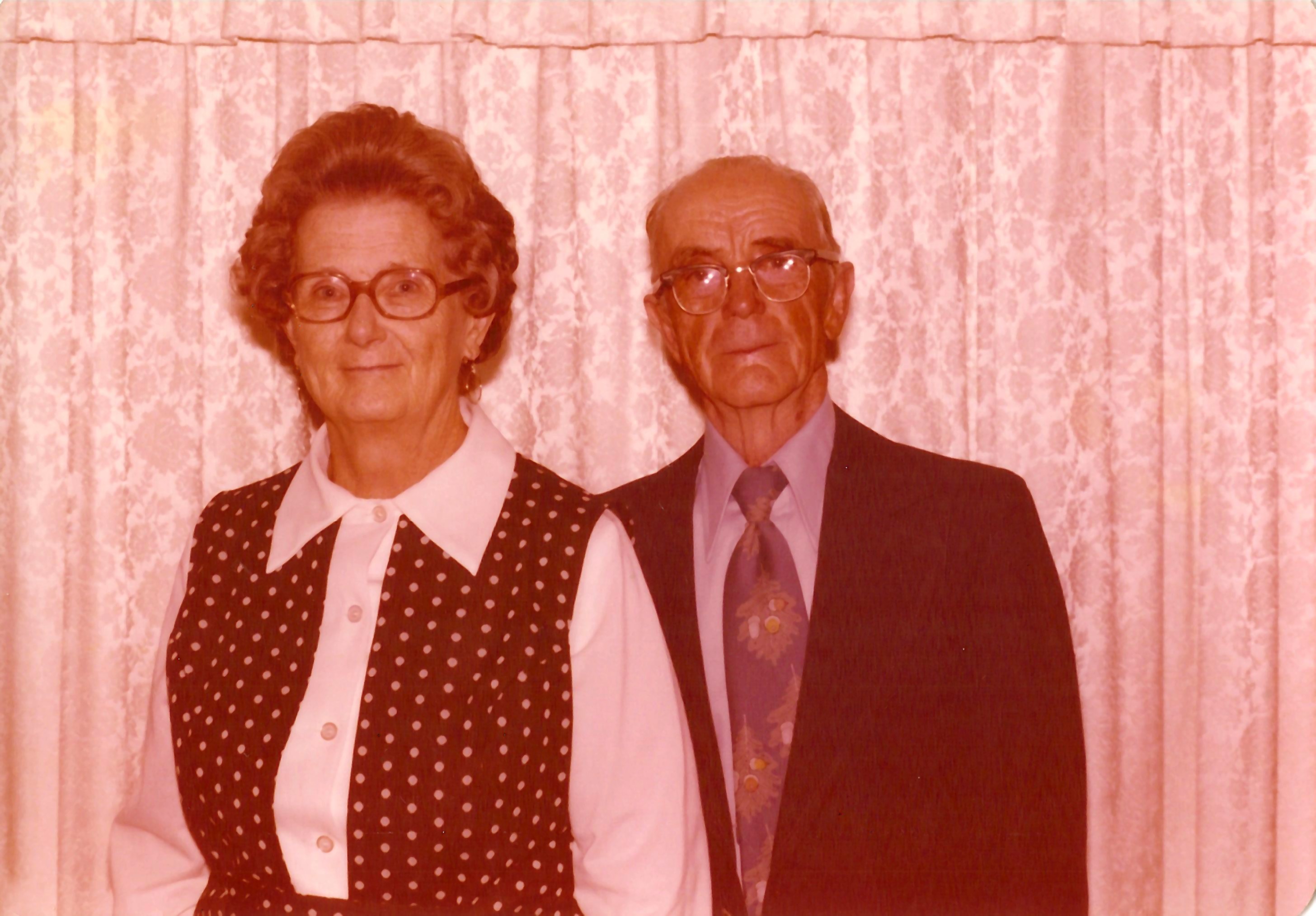
The best thing about writing this article though is that I got to name drop some of the parishes I grew up in as well as one of my beloved family members, my great-aunt Florence Fagan. Florence was my maternal grandfather’s sister. She lived all her life on a farm in Iowa. She and her husband, Francis, had four children: Ruth, a Franciscan sister in Dubuque; Marie, who has her own farm in Iowa; Joe, a former priest who founded the activist organization Iowa Citizens for Community in Des Moines; and Jean, a teacher New Orleans. Florence, Francis, Jean, and Joe have all passed away.

My great-aunt and great-uncle, Florence and Francis Fagan, of Iowa.

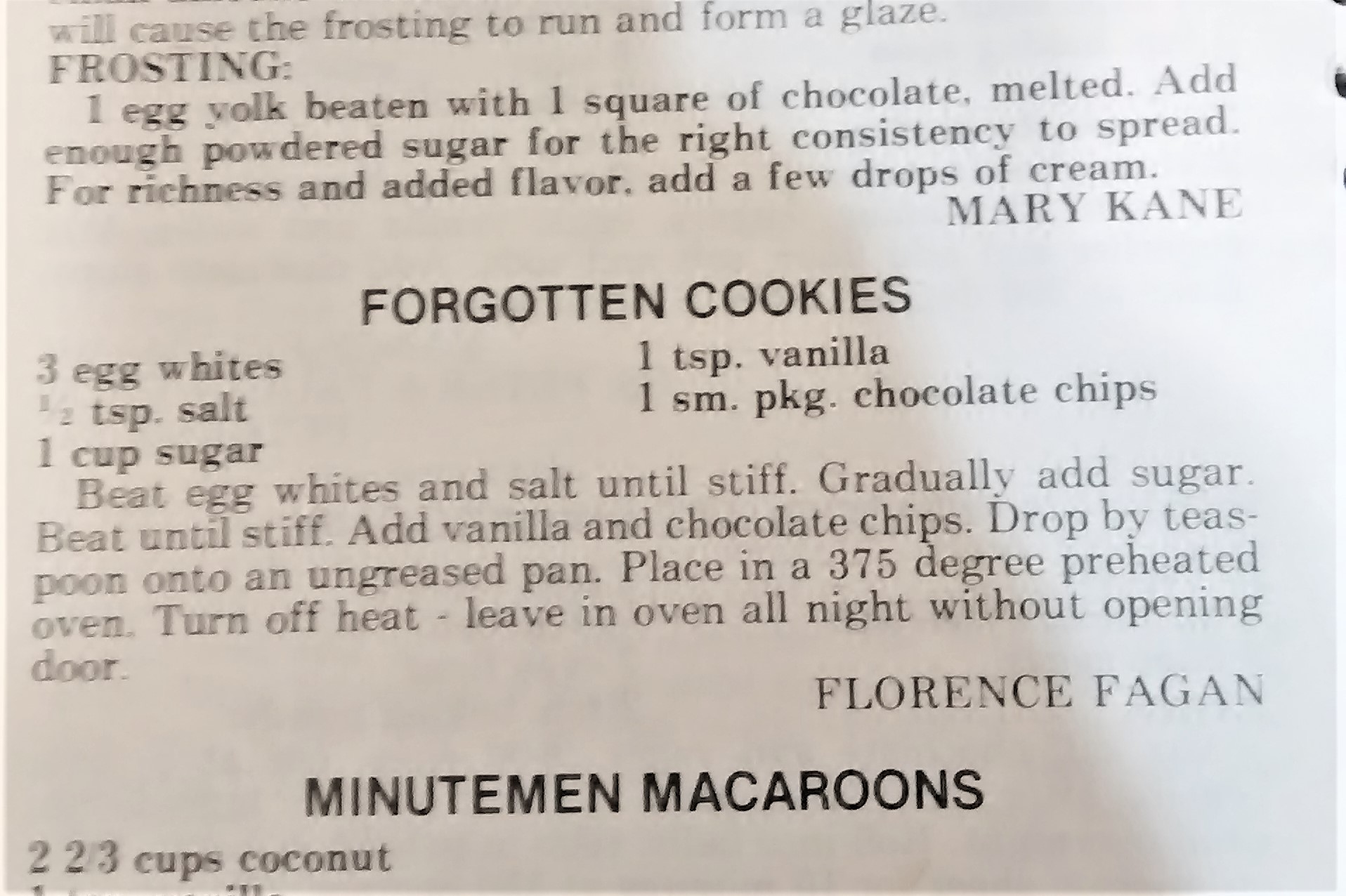
The New Melleray Abbey cookbook mentioned in the article has at least a dozen recipes by Florence–nearly all desserts. For the curious, here’s her “Forgotten Cookies” recipe in its original “parish cookbook” form:

Ancestral Hunger Pangs

This is the last editor’s note/essay I wrote for Tiny Donkey. As I wrote in a previous post, Tiny Donkey was a digital journal devoted to short nonfiction about fairy tales and folkore and associated with Fairy Tale Review. It was shut down in 2017, and its site was recently taken down from the internet completely. I’ve been rescuing all the essays and interviews I contributed here. This one was my favorite of all.


My mother’s kitchen cupboards are stocked with ancestral memories; crammed with what may look like ordinary jars and cans, boxes and bottles—but I know better. These are her hunger ghosts, I think to myself every time I open the cupboards, doppelgangers of old wounds and inherited hurts.

The same goes for the freezer and fridge, the fruit bowl, even the jar for cat treats. My mother hoards food. She consistently buys too much, as if she’s still cooking for a household of eight or preparing for a food shortage or a spell of famine. She overcooks too, long used to making large casseroles that needed to stretch into a couple days’ worth of leftovers. My father and I have tried talking to her, telling her to scale back, that we cannot possibly eat everything before it spoils and it’s a sin to waste food.

But I think she really is preparing for a famine, or reckoning with the haunting of one. My mother descends from the Famine Irish, the generation that left Ireland in the mid-19th century for their lives, escaping starvation and fever, mass death, and the devastation of centuries of British colonialism. Hunger is the reason she’s here, in America, and half the reason I’m here too, along with my brothers, sisters, and all my maternal cousins.

In Irish folk belief there’s a type of grass called an féar gortach, the hungry grass. Some say it’s a different shade than the green that famously carpets Ireland, more silver in color, or patchy and withered. Others say it looks like any other grass, and you only know you’ve stepped on it too late, when a great hunger suddenly comes upon you and nothing can cure it save a bite of some bread tucked away in your pockets (if you had the forethought) or a bit of your own shoelace (if you’re really stuck). It’s said hungry grass grows wherever a corpse has been laid down or someone has died. The belief predates An Gorta Mór of the 1840s, the Great Hunger. But an féar gortach took on a new, ghastly meaning then, in an era when famine victims were found in fields and on roadsides, a ring of green around their open, lifeless mouths after a last, desperate meal of grass.

As Ireland’s potato crop failed and its people starved, its other crops were harvested and exported by the shipload to serve on British dinner tables and fill British bellies. At least a million Irish died during the Famine, their bodies buried in mass graves wherever their lives gave out. In a sense, all Ireland’s green countryside turned to hungry grass, a landscape of want and loss, of lasting trauma and emptied beauty. At least another million emigrated, became refugees, exiles, Irish-Americans, Irish-Canadians, Irish-Australians, hyphenated people, diasporic, hungry.

Growing up, Mom spoke often of her family’s history, sang and played us Irish folk songs, explained to us the Famine, dressed us in green on St. Patrick’s Day. Maybe it seems a stretch to suggest my mother’s food compulsions have anything to do with an event in another country her ancestors left fadó fadó. But some events are simply too large, too traumatic not to eat into the blood, the DNA, the collective cultural memory of a people.

Mother’s ancestral memories transferred to all her children, but might have absorbed most deeply into me, her last-born child and the only one to go live in Ireland years later. I am the child who’s never married, never had children. Who’s struggled with her weight, eats when she’s not hungry, and bakes when she’s sad or simply bored. Who collects cats, books, and passport stamps like they’ll fill up some loss, some second-hand but deep-rooted want and need. The famished one, always looking for some patch of grass where the hunger finally makes sense.

Mom in Ireland, 1969.