Generation Kool-Aid

“I was never writing to become the voice of a generation and I was never writing thinking that I was an enfant terrible. I was just writing what I wanted to write and it was other people who decided that I was or wasn’t those things. I don’t identify with either one.” –Bret Easton Ellis

“I certainly never intended to speak for anyone other than myself.” –Sally Rooney

“I think I might be the voice of my generation…or at least, a voice of a generation.” –Lena Dunham (as Hannah in Girls)

Not long after I graduated from high school (class of 1990), I became a perfect mark for books backed by a specific marketing strategy. And by this I mean books that are shilled as generational touchstones.

You know the kind of books I mean. The Great Gatsby. The Catcher in the Rye. On the Road. Infinite Jest. Prozac Nation. Anything by Halle Butler or Sally Rooney. Anything by Lena Dunham. The Fire Next Time. The Sun Also Rises. Jonathan Livingston Seagull.

That last one might seem far-fetched, even to those who’ve heard of it. An earnest, nazel-gazing little novel about, yes, a seagull, it became a best-seller in the early 70s, a time when many Americans were on a similarly earnest journey of nazel-gazing self-discovery.

Have I read it? Please. It came out in 1970, two years before I was born. By the time the book was on my radar, as a pre-teen and teen of the 80s, such late-hippie affectations had become a ruthless punchline.

By the mid-80s, a book like Jonathan Livingston Seagull might as well have been written in the Victorian Era or the Stone Age for all it spoke to readers of the new crop of books coming out. Specifically, the new crop that was being marketed to a certain kind of reader.

I was about 13 years old when Bret Easton Ellis’s debut novel Less Than Zero came out, in 1985. I have no memory of it as a book until the widely panned movie version was released a couple years later. Which was rated R so I didn’t get a taste of that either in real time.

But Ellis, who was 20 years old when he published Less Than Zero, was already being anointed the “voice of a new generation.” And he was being lumped in with a bunch of other relatively young writers who were dubbed “the Literary Brat Pack.” Jay McInerney, who had just published Bright Lights, Big City in 1984, at age 29, was one of the pack. So was Tama Janowitz, who came out with Slaves of New York in 1986, when she was about 28. Depending on your sources, Michael Chabon was also part of the Literary Brat Pack, as were Meg Wolitzer, Jill Eisenstadt, and Donna Tartt.

Decades later, the truth would come out that some of these writers barely even knew each other. Never mind the photos in such rags as Vanity Fair of what appeared to be Janowitz and Elllis and McInerney all partying together at some glamourously boozy writers’ event in NYC. In a 2016 Harper’s Bazaar article about the Literary Brat Pack, Janowitz said of Ellis and McInerney, “I didn’t know those guys. We would bump into each other at various things we had been invited to, but it was like creating a movement, as if somehow we had been hanging out together beforehand.” Ellis concurred. “I really can count on one hand the number of dinners I actually had with her.”

But for lack of another name for this “movement,” the “Literary Brat Pack” it was for any writer under age 30 who had published a novel to decent reviews between the mid-80s and early 90s.

Soon, however, there would be another name for this bunch, and for those who followed them and those who read them.

In 1989, the year I entered my senior year of high school, Newsweek magazine came out with a special issue on “The New Teens,” featuring a cover of three spunky teens, I guess, and enticing headlines like “What Makes Them Different” and “Who Are Their Heroes?” and “Advice from Judy Blume, Grace Slick, John Waters.”

Unlike Less Than Zero, I vividly remember this issue. The cover, at least. I can’t recall what was on the inside, like, who “their”–meaning my and my friends’–heroes were supposed to be. Or what advice the woman who sang “Feed your head” in the 60s could have possibly had for me. (I probably appreciated John Waters’s words of wisdom though.) I know I talked on the phone with a friend about the issue. I remember he wanted to know what I thought of the kids who were interviewed. We might have made fun of it all. Or maybe we took it seriously.

The point is that even though Newsweek was the kind of magazine your parents or school libraries subscribed to, not the kind of rag that teens willingly sought out and purchased, it got our attention.

The following year I graduated from high school. I had no idea what to do with my life, and in fact I bucked the trend at my school and didn’t go to college right away. Not even a community college. I had a vague notion of wanting to travel. To go on the very same journey of self-discovery that was promoted by books like Jonathan Livingston Seagull.

Or On the Road. Now that book, Kerouac’s book, a “voice of a generation” book from an even earlier time, I had read. And I’d loved it.

I’d also read a few likeminded books recommended to me by friends. Tom Wolfe’s The Electric Kool-Aid Acid Test. Douglas Adams’s The Hitchhiker’s Guide to the Galaxy. Tim Robbins’s Even Cowgirls Get the Blues. More books about journeys and discovery, about bucking society’s expectations in defiance of the fuddy duddies of yesterday. Only thing is, with the exception of Adams’s kooky novel, these books all belonged to yesterday, to a generation definitely not my own.

But that didn’t seem to matter to me.

Because by this time I’d also read a few of the Literary Brat Packers. McInerney’s Bright Lights, Big City and Story of My Life. Janowitz’s Slaves of New York. I wasn’t sure what to make of them. As far as I could tell, they all seemed to be about cocaine. With a little bit of Wall Street, art, and fashion thrown in. I mean, as a recent high school grad from Illinois, I could relate to stories about people who just want to jump in a car or a spaceship or DayGlo-colored school bus and zip around the country or universe with friends. But snorting lines in a toilet stall in a gallery in SoHo was completely beyond my comprehension.

I kept at it with the Literary Brat Packers though, maybe with some hope that reading the writers “of the moment” would help me figure out what it meant, if anything, to be a freshly minted adult at the end of the millennium.

So when McInerney’s Brightness Falls came out in 1992, I gave it a read. Another novel of 80s excess set in NYC, it had something to do with a brilliant and successful couple’s downfall. I recall thinking that it was a more mature work, Gatsby-like in ambition. Definitely a “statement novel.” But also totally beyond the understanding of a 20-year-old retail and food-service worker from the Midwest.

Perhaps it’s no wonder, then, that when Donna Tartt’s much-heralded debut The Secret History came out that same year, I was becoming skeptical of works by hot young writers. To some degree, Tartt’s novel might have been a tad bit closer to home. Its main characters were college kids after all. People my age at the time. But…these were rich kids at some ritzy liberal arts college out East. (Tartt, like Ellis and Eisenstadt, was a Bennington alum.) One of the book’s characters, as an elderly woman I worked with at a local library scornfully remarked, is a guy named “Bunny.” So yeah, I passed.

In the end, it didn’t matter. The days of the Literary Brat Pack were numbered.

In 1991 a Canadian author named Douglas Coupland published a novel called Generation X: Tales for an Accelerated Culture. Coupland was 29, but he wasn’t being put forth in any way as the voice of a new generation or the member of a pack. His “novel” wasn’t even that. Instead, Generation X was something of a quaint throwback to medieval works like The Canterbury Tales and The Decameron–a rather plotless collection of stories told by a group of disaffected 20s-somethings in California.

But if the premise was old, the delivery was new. For one, there was no standard 8.5 x 11 inch hardcover edition of Generation X or even a standard paperback edition. From the get-go, it was published as a rather oddly dimensioned 7.85 x 9 inch softcover book with a cloudscape stretched across the top half of the cover and a solid band of orange, green, yellow, or white across the bottom. It felt like a big floppy disk. On the inside, it resembled a zine. The margins were peppered with somewhat dispiriting facts about modern society, zeitgeisty graphics, and call-outs of terms invented by Coupland, like Successophobia and The Emperor’s New Mall and the soon-to-be-timeless McJob.

This was legitimately something new. Something that felt fresh and intriguing. Remember that Newsweek cover? What makes “the new teens” dfferent? However Newsweek answered that in 1989, the magazine probably didn’t see Coupland coming.

Nobody did. Because Coupland didn’t get the Vanity Fair treatment. Not at first. And the book was something of a word-of-mouth sensation, not the kind of novel to be featured in your local library’s book discussion group. Which was perfect for a book that came to represent a determinedly anti-brand and anti-consumerist generation.

As for the title, Coupland was inspired by a chapter in Paul Fussell’s 1983 nonfiction work, Class: A Guide Through the American Status System, a book I never even heard of. Thank the lord that someone else has. In the newsletter Culture: An Owner’s Manual, W. David Marx writes, “The final chapter of Class is called ‘The X Way Out’ where Fussell identifies an emerging group in society he calls ‘Category X’ — well-educated, Bohemian-like consumers who construct obscure lifestyles in order to transcend traditional status symbols.” Marx makes the argument that by titling his book Generation X, Coupland “decided to define his generation by its aesthetic choices — specifically, fighting the class hierarchy through the focus on cultural and subcultural capital over economic capital.”

In other words, Coupland was resisting the pigeonhole marketing of his generation, and his book, right there in the title.

Before you knew it, Ellis, Tartt, Coupland, Chabon, and even McInerney were being labeled Generation X writers. Or, at least, writers whose works and characters represented the experiences of Generation X. Never mind that the generation itself was soon defined as people born between 1965 and 1980, and several of these supposed “Gen X” writers went back to the 1950s.

It didn’t matter. There was no going back now. The term was out there, and no doubt marketing teams across the country breathed a sigh of relief. Now they could claim for their own purposes a catchy yet edgy name for the coveted youth demographic. Because just like it’s easier to communicate to a crowd contained in one area, instead of blaring from a loudspeaker pointed in all directions over open ground, it’s much easier to shill to people who’ve been wrapped up with a label.

Names are tricky things. They give things legitimacy and anchor them in meaning, but when applied to a large group of people, they reduce those people to a captive audience. And with a captive audience you can make people listen to or do almost anything.

As anyone who’s ever perused a catalog or read an astrology chart knows, the next step after labeling something is to describe it with a few punchy yet vague predictions and adjectives, the kind that can apply to anybody at any time. Ideally, the adjectives should be semi-flattering. They should hint at distinction and specialness, at some je ne sais quoi that sets this…thing…apart from all the other things before and after. You do want people to buy what you’re selling after all. If you really want to spice it up, you should also toss in some element of danger, a hint of caution, a touch of the forbidden. Not so much to set off any “buyer beware” alarm bells, but enough to stir the buyer’s curiosity.

So, if it’s a group of people you’re trying to sell and sell to–specifically, a group of people born between this year and that–you might flatter them by saying that they’re already much wiser than the people born before them. You also might tell them that nobody’s seen the troubles they’ve seen before, which is flattering in the sense that it validates their anxieties and fears, even if it is quite condescending and possibly even absurd (considering that humans have been dealing with all kinds of crap for centuries now).

To put an edgy spin on it–because young people love to walk the edge, I guess–you can rebrand their so-called preternatural wisdom as “cynicism” and their anxiety and fears as “apathy.” If that seems to lose ’em, reel ’em back in by telling them that they’re, say, “diverse,” so much more “diverse” than the people who came before them. In all the history of the world, no one has ever “diversed” as much as these “diverse” young folk have “diversed.” It’s really quite commendable.

If any of this sounds familiar to you, if it sums up you, your friends, and school chums, even for just 10 seconds of your life so far, congrats! You’ve got yourself a generation: Generation X!!!!!!

Or maybe this label is supposed to go with Millennials. Or Gen Z? Or the Lost Generation? Or Libras. Maybe Geminis. Yeah, that’s it: Gen Z Geminis with a diverse no-foam Greatest Generation moon. Maybe the label is b.s. Maybe we can make it mean whatever we want it to mean. If one generation rejects it, recycle it for the next. Young people, they like recycling.

But back to Coupland’s Generation X. It wasn’t long before Coupland found himself in the “voice of a generation” club alongside Ellis and Tartt. Meanwhile, McInerney and Janowitz kind of dropped out of the picture, while others filled the void. David Foster Wallace. Zadie Smith. Elizabeth Wurtzel. Dave Eggers. Colson Whitehead.

No surprise that Coupland rejected the label, even if he did keep writing about the pecularities of people under age 30 as if he, too, wanted to corral them into some kind of subclass. Case in point, his second novel, Shampoo Planet, came out in 1992 and centered on the younger sibling of one of the main characters in Generation X–a determinedly anti-Boomer Alex P. Keaton-style “global teen” named Tyler who at one point declares “My memories begin with Ronald Reagan.” Confusingly, Coupland defined “global teens” as “alien to X as X is to baby boomers.” Even though the “global teen” characters in Shampoo Planet belonged to the X years, as the generation would come to be defined.

That kind of confusion should have been a warning against taking generation labels too seriously. But as we stand now, in 2025, generational labeling (and bickering) has been dialed up to 11 since the days of Coupland et al.

When it came to the first books that got the Gen X label, I have to admit I drank the Kool-Aid. Generation X thrilled me when I first read it. Not that it resonated with me. Who needs resonance when you’ve got that cover! Those call-outs! That marginalia!

I remember I was especially eager to read Shampoo Planet, even if Coupland’s “global teens” comment did mystify me. His comment that the book was specifically about people under age 25 (which I was at the time) is what got me hooked.

But Shampoo Planet left me wanting. Just as with those coke-snorters in Slaves of New York, I didn’t relate to Tyler and his friends. The title, for example. It came from Tyler’s obsession with hair and grooming. That alone felt like b.s. to me. Still does, especially when you consider that this novel came out one year after grunge took over with Nirvana’s “Smells Like Teen Spirit,” another so-called generation-definer. It also followed on the heels of Ellis’s American Psycho, a extremely violent novel about a serial killer that became a bit of a rallying cry for free speech–and also centered on a young charater obsessed with grooming. For the record, Ellis did it better, had more of a point with it, knew what his targets were.

But which was it? Were we preps or were we slobs? Achievers or slackers?

I couldn’t tell you. As a reader, I removed myself from the debate. I didn’t read Zadie Smith or Donna Tartt or Bret Easton Ellis or Dave Eggers–not until much later. Forget Elizabeth Wurtzel. I thought her book covers were a joke, an obvious ploy for “controversy”–maybe not engineered by her, but still. Twice I made an attempt at Infinite Jest. Interesting writer, but I didn’t get very far either time.

Instead, I just read what I wanted to, no matter when it was written and who the book was supposed to be aimed at. I read a lot of Irish literature, including some current folks (Roddy Doyle, Pat McCabe, Colm Toibin). I read Romantic poets and classic American texts and celebrity bios and African American fiction and books by women. I fell in love with the novels of Louise Erdrich, Tayari Jones, Emer Martin, Cormac McCarthy, and Toibin. I loved Frank O’Connor. I loved Lonesome Dove and Kristin Lavransdatter, two epic masterpieces that are worlds apart in setting and style. I read more poets. I adored Shelley and Keats, Yeats, Kevin Young, Frank O’Hara, and Nuala Ni Dhomhnaill. I liked random reads like Hector Tobar’s The Last Great Road Bum and Mike Tidwell’s Bayou Farewell and Richard Rodriguez’s Darling and Fernando Pessoa’s The Book of Disquiet. The Creative Quest by Questlove. That book by Patti Smith where all she talks about is her favorite detective shows and coffee.

Sometime in my 40s I finally circled back to Generation X. By this time, people my age had long passed the expiration date on coolness and no one was putting us on magazine covers anymore asking what makes us different, partly because magazines had become about as relevant as a Richard Brautigan novel. Or Jonathan Livingston Seagull.

Gen Xers were already getting lumped in with Baby Boomers, our one-time enemies, who in turn were suddenly being burned at the stake for everything from hastening climate change to ruining Facebook. More often than not, Gen Xers were overlooked entirely. Skipped over from Boomers to Millennials. Like we weren’t there, hadn’t made so much as a dent in the culture.

Maybe all this societal change and generational name-calling stirred in me some sense of territoriality mixed with nostalgia. Because I started checking out some of the heavy hitters of my generation’s salad days. A collection of David Foster Wallace essays (pretty good…a mixed bag if anything). End of the Road. OK, that’s a movie, but a movie about Wallace. White Teeth. (Liked it.) The Goldfinch. (Started out decent then became a slog.) The Interestings. (Meh.) A Heartbreaking Work of Staggering Genius. (Ugh. Did. Not. Finish.) Less Than Zero. (I had no idea it was a Christmas story.)

Mixed in with these reads were some by the new kids. Normal People. (OK.) Beautiful World, Where Are You. (Ugh. Did. Not. Finish.) Eileen. (Not bad.) Self-Care. (Yeah, dumb.) My Year of Rest and Relaxation. (Also not bad.) The New Me. (Pretty good.) Banal Nightmare. (Also pretty good but the relentless nastiness starts to feel like “uh huh, uh huh, flips pages to move it along.” I can be convinced otherwise though.)

And yet, say I saw glimmers of myself in those books. My younger self, my current self, whatever. Say there were parts that resonated with me. Parts that made me laugh, made me feel wistful. Say there were characters who felt like people I knew. Places and scenes that felt so true I could picture them as if they were playing out right in front of me. Given that these are supposed to be “Millennial” books, and I’m no Millennial, is that a bug? Am I just imagining universality? Or is that a feature?

Maybe it’s what literature is supposed to be. And maybe it’s what humanness, no matter when you’re born and when you die and what years fall in between, is supposed to be.

In 2021 Bret Easton Ellis came out with The Shards. Ellis has become something of a cranky old man in recent years, but a cranky old man who is ride or die for his generation. No surprise then that The Shards is something of a love letter to the 1980s. Its music, its movies, its hedonism. Much like those coke-addled tomes of the Reagan era, The Shards is about people with whom I have nothing in common other than sharing the Earth around the same time in history. Much like Less Than Zero, its characters are all spoiled, amoral rich kids in Los Angeles who do a lot of drugs and have a lot of sex, always with a pool nearby. In The Shards, though, there’s a plot about a serial killer that somehow…makes you feel for these trashy teens. It’s a gripping read, but that’s not what surprised me. What surprised me is that it resonated with me. That it almost felt like, yeah, this was the 80s. This is Gen X.

It could be that nostalgia has finally primed me for the kind of marketing that accompanied Gen X novels of the 90s. That in the face of rapid change, I’m giving in to a Kool-Aid flashback and clinging to something familiar. Nodding along to the spiel, happily handing over all my money, buying the T-shirt and not even pretending anymore that I’m wearing it “ironically.”

It’s also possible that Ellis just wrote a good story. Did he write it for people like me? Or any and all takers?

Most likely the latter. It sounds dumb, after all, to propose that Fitzgerald wrote The Great Gatsby for flappers and bootleggers, with no eye on immortality. Kerouac originally modeled himself after Thomas Wolfe, a serious and conventional novelist. Then he wrote On the Road. That novel wasn’t him throwing in the towel, and it certainly wasn’t him trying to set a trend by catering to an as-yet undefined generation of rebels, beatniks, drop-outs, and seekers. The very idea is, again, dumb.

Instead, On the Road was a self-serving creative breakthrough–as all swing-for-the-fences literature should be. It’s why young people still fall in love with the book decades later. And why crabby old post-menopausal hags like me can admire and look forward to a new Halle Butler novel, as well as a new Louise Erdrich. Even a new Bret Easton Ellis.

Generations come and go. Good stories are for the ages.
Mixed Messages

“In life, there is no real safety, except self-belief.” –Madonna

So…another digital mag that I had a piece published in a few years back has gone down. The piece, an essay called “Mixed Messages,” about Madonna for the music memoir mag Memoir Mixtapes, is still available through a direct link but is otherwise not searchable. Memoir Mixtapes’ website is disappeared, though their Medium site, which featured shorter memoir-form song recommendations (including a few of mine) is still accessible.

With the main website going defunct, and with Madonna’s birthday coming up in a few days (August 16), I thought I’d reshare the essay here. The theme for the issue it appeared in was “Back to School.” So I wrote about a boy I had a crush on back when I was 12 or 13, who I once slipped a note to with some questionable Madonna lyrics. Along with unfortunate puberty-fueled crushes, the essay gave me a chance to think about the influence that Madonna–a megastar to Generation X kids and to the world, really–had on me. I was a fan. Of her music–and of her.

In this day and age, as Madonna has entered definite senior citizen status and a multitude of female pop stars who most definitely drew from her look, style, and sound have risen to fame, it’s become a trend to deride her mercilessly. On social media, dopes leave cruel and gross ageist remarks on her posts, and people call her desperate and irrelevant. I don’t get it. Madonna was unapologetically ambitious, sexually confident, and femme-presenting in a time when many female musical acts and celebrities could still not be all three at once–and definitely not the first two. Seriously, it was her and Grace Jones. She shattered sales records, concert records, chart records–for female music artists and for music artists in general. If that wasn’t enough, she advocated for gay rights and AIDS research at a time when there were literally only two celebrities publicly speaking out. It was her and Liz Taylor. Less remarked upon is her longtime championing of artists from her home state of Michigan–over the years, she’s supported Eminem, Michael Moore, Iggy Popas well as Black, female, and LGBTQ artists. A few years ago, she gave a brilliant speech on what it’s been like to be a trailblazing woman in the music industry at a Billboard Music event honoring her. And she rightly continues to NGAF and keep on keeping on no matter all the ageism and sexism lobbed at her by the clueless crowd online. Because of course, one day, they’ll find out themselves. (And I hope I’ll still be around to remind them what jerks they were.)

In my essay, I wrote a bit about what it was like to hear Madonna for the first time and follow her story–this upstart who grew up in a large, lower-middle-class Catholic family in the Midwest with audacious plans to rule the world, as she said on her first appearance on American Bandstand. Madonna’s gay male fanbase is well-known, and still fiercely supportive of her, but I can’t be the only Gen X Midwestern Catholic girl who also adored her, taking subconscious note of how she represented and challenged all the “mixed messages” thrown at girls and women in American culture. And Catholic culture. No music artist challenged the church’s misogyny and hypocrisy so boldly as Madonna–until Sinead O’Connor came along. It’s a pity the two women (supposedly) don’t like each other and never collaborated. They have more in common with each other than not.

This essay is as much about being a girl on the verge of becoming a woman. It’s written more from the viewpoint of that age, but with some interfering adult humor and wisdom–so I guess it has some mixed messages of its own. I’ve included some videos that weren’t in the original issue, which was released with a playlist of all the songs written about all the contributors. I’ve restored a couple instances where edits were made to my essay that I didn’t really agree with. My crush’s name is a pseudonym, both in the original and here, just FYI. I hope you enjoy.

Mixed Messages

The first love poem I ever gave a guy I stole word for word from Madonna. The “poem” was
the lyrics to “Burning Up,” an intensely lusty number off her first album, and the guy was a
boy at my high school whom I thought looked like Sting.

His name was Craig [not his real name], and like the woman whose song I gave him, he had a reputation.

Back in the 8th grade, when I started crushing on him, he’d been a jock verging on burnout,
or maybe a burnout verging on jock. Thirteen is that kind of liminal age when you can
easily embody two personas, no matter how contradictory, like a honey-sweet A-side with
a dirty-horny B-side spinning away underneath. If you’re a boy, that is. If you’re a girl, still
inexperienced and unsure of yourself, yet already developed, already drawing the kind of
attention better suited to a woman twice your age, it’s not so easy. People will say you’re
giving off mixed messages. They’ll call it “attention seeking” or “showing off.”

Craig was popular and I wasn’t. He was on the football and wrestling teams and I wasn’t on
anything. He reportedly hung out in other kids’ basements after school to drink and
smoke. After school I went to more school, to CCD, aka Catholic education for kids whose
parents couldn’t afford parochial tuitions. Craig had spiked blond hair and acne, was twice
the size of most the other boys, and wore a near-daily attire of black concert tees
advertising one metal band or another. Metallica, Slayer, Iron Maiden…bands I never
listened to or got near in my musical taste. Bands I probably wouldn’t have even known
about if it weren’t for their appearance across the muscles of Craig’s chest.

My thing was pop music, like top 40 radio hits and heavy rotation MTV faves. I liked songs
you could dance to. Michael Jackson, Janet Jackson, Prince, and yes, Madonna, whom I
took a special interest in for a completely inconsequential and self-centered reason. We
share an unusual name. Madonna is my middle name and my mother’s first name, and I
had never known anyone else called Madonna, other than the Virgin Mary—which, in an
era of classrooms crammed with Jennifer Lynns and Julie Annes, only made the name even
more extremely weird and uncool.

Until “Holiday” came along.

I was 11 when I first heard it, on the radio one winter Sunday while listening to Casey
Kasem’s countdown. Not listening actually, but dancing. Alone, in the room I shared with
my sister A, four years older than me but the closest to me in age of my five siblings. We’d
been roomies since I was born, sometimes even sharing a bed in the very full houses we’d
grown up in, first on the northwest side of Chicago and then in a suburb known for
nothing but a don’t-cough-or-you’ll-miss-it mention in The Blues Brothers.

I remember hearing Casey’s introduction to “Holiday” and thinking I misheard the singer’s
name. Once the song started, I fell immediately for its peppy beat and message of
celebration and togetherness. I was a misfit kid, a bookish loner who got bullied at school
for my weight and glasses and crooked tetracycline-stained teeth, and my outsider
experience made me a sucker for any song that pleaded for people to come together
despite their differences, even for “just one day out of life.” Dancing, like books and music,
was an escape for me, from the crowded physical spaces of home and the perpetual sense
of social awkwardness and ugliness I felt at school. Dancing was where I could pretend I was someone else, someone graceful and beautiful and cool. All it took for transformation
was a good song.

After the song’s fadeout on the countdown, Casey repeated its title and the singer’s name
and where she came from: Detroit, meaning the Midwest. Same as me, I thought. And in
the easily impressed way of young misfit girls, that was all it took. I was a fan.

It wasn’t long before I got to see this doppelganger of mine, on American Bandstand, lip
syncing and skipping around to that same great song from Casey’s countdown. If I’d been
under the notion she and I had much in common, her appearance on Bandstand quickly put
an end to that. Her look was streetwise, not suburban schoolgirlish. She wore all black, lots
of makeup, and fabulously messy hair. Her skippy-kid dance moves didn’t seem hard, but
when I tried them later in my room it proved a challenge keeping up that energy for a
whole song. She may not have been impressive vocally (live or on record), but there was
something magnetic about her, something almost feral in her facial expressions that jarred
with her song’s utopian lyrics but fit perfectly with her disco-punk-gypsy getup.

Then there was the confidence—sexual, professional, just all-around. To this day, I’ll
maintain that’s what rubs people about Madonna, what explains the perpetual trashing
she’s gotten since 1983—her audacious, undeniable, gender-role-busting self-belief. After
her performance, as Dick Clark tried to interview her over the screaming kids in the
studio, she couldn’t stop smiling and giggling at her success and sudden popularity. When
Dick Clark asks her if she was scared to go out on her own as a performer, she answers,
“Not really. I think I’ve always had a lot of confidence in myself.” Then she lays it right out
for us. “What are your dreams, what’s left?” Clark asks her. “To rule the world,” she says,
capping it off with another giggle.

“Look at this girl,” one of my older siblings (a baby boomer to my Gen X) said dismissively,
making disparaging comments about her bared bellybutton and visible bra straps. Like,
who did she think she was? Going on TV, enjoying herself, dressing slutty, dancing around,
plotting world domination.

I don’t think it’s possible for me to understate the significance of that Bandstand
performance, the seed-planting, what it was like as a suburban Midwestern Catholic girl to
see this other suburban Midwestern Catholic girl who’d not only escaped to something
bigger and better but was demanding more. Without apology.

IYKYK. Courtesy of Click Americana.

My sister soon got Madonna’s first album, but I got more use out of it, dancing to it in the
basement every week. Madonna may have been too local for A’s taste anyway. She was
mostly a Brit-band kind of girl. When she hit her teens, she’d begun covering the walls of
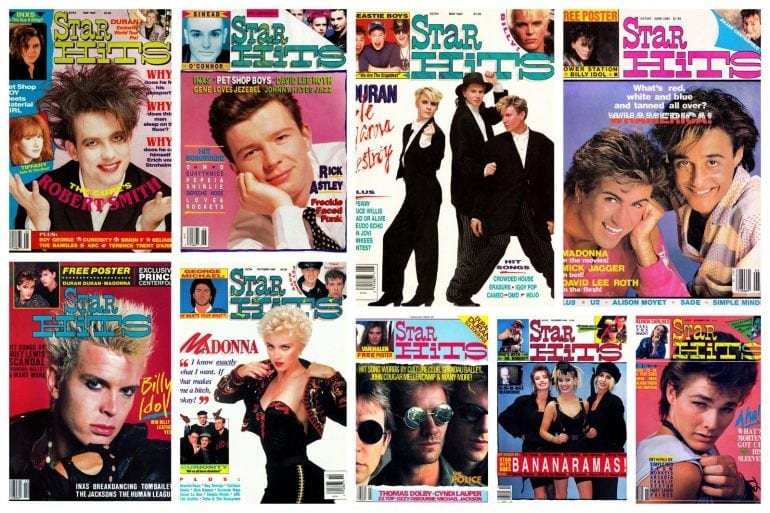
our room with Star Hits tear-outs of Duran Duran, Howard Jones, and Culture Club. They
took the place of my Muppets poster and her small B&W cut-outs of Matt Dillon from the
Chicago newspapers’ weekend movies section. On our closet door hung a huge poster of
that blonded-up post-punk trio The Police, A’s favorite. We fought over this space—I
wanted it for an MJ poster featuring the King of Pop in white slacks and a yellow cardigan
and matching bowtie. When A didn’t relent, I took her stick deodorant and defaced Sting
and Co’s faces with it. As it turned out, deodorant scrapes right off poster paper (who
knew?) and for years I had to contend with falling asleep under the sexy-intellectual gaze
of The Police’s lead singer night after night. Subconsciously, I must have started seeking
that same gaze among the boys at my school. Because one night, when I was just turned 13,
it struck me while staring back into Sting’s eyes: with that blond spiky ‘do and those
cheekbones and muscles, he kinda sorta looked like that one tall guy at school. Metallica
guy. Craig.

It was too bad Craig was all wrong for me. As in cool, popular, and rebellious where I was
shy, self-conscious, and unknown. We had no classes together, nothing in common socially,
and I was sure he didn’t know I was alive. He said as much when someone squealed my
crush on him. “I don’t know who she is,” he said, according to the girls who told him. Later,
presumably after someone pointed me out to him, he told our one mutual friend, “She’s too
nice.” And I couldn’t decide which was worse—being invisible or being innocent.

Something had to change and that something had to be me. I wanted so badly for it to be
me.

The truth was my life had become overwhelmed by changes. After turning 13, I got my first
period, having already developed physically—breasts, hips, height, the works—beginning
around 10 or 11. My older siblings started getting married off. And most life-changing of
all, my grandmother had had a stroke and had come to live with us. She was given the
room I shared with A, and all our music mag pics were taken down and replaced with
pictures and statues of the Holy Family and various Catholic saints—Madonna for
madonnas, you might say. A moved into a room formerly occupied by one of our brothers,
and I moved into a tiny tandem room off hers, about the size of a large walk-in closet. After
school, I had to be home to help look after my grandmother with my siblings, as our
parents worked full-time.

There comes a time in every young girl’s life when she senses things aren’t under her
control, that there are rules she’s supposed to abide by that she didn’t make and
expectations she has to live up to that she can’t possibly meet and taboos she shouldn’t
break that she suspects wouldn’t even be on the radar if she were a boy. Most girls react to
this realization head-on, and many by trying to take control over the one thing that all
these rules and expectations and taboos seem to apply to—her body. I was no different. If I
couldn’t stop change from overwhelming my life and overtaking the space I’d tried to
carve out for myself, I could at least try and make it work for me.

So I lost weight. A lot. I did it my way and the textbook teen girl way—dancing for hours to
records in the basement after school and eating as little as a scoop of cottage cheese for
dinner and a milk carton for lunch every day. It was only the beginning.

After graduating junior high, I spent the summer getting ready for high school reflecting
on possibilities, on the dream of having a completely different look, a completely different
social life—really, any social life. Meanwhile, A was going away to college, giving me her
room and everything in it she left behind. Her last couple years of high school, she’d begun
replacing her music mags with fashion rags, bookmarking spreads of stylish women whose
looks she wanted to copy and elegant rooms whose décor she wanted to surround herself
in. She’d always had a fashionable touch that I lacked. Studying her leftover, well-thumbed
through copies of Vogue and Mademoiselle, I knew such transformation was hopeless for
me, even newly skinny as I was. I was too hungry for high fashion—hungry to be noticed,
to be loved, to stop being so invisible and innocent.

Who else could I turn for a role model but to Madonna, by now the queen of everything, not
just a pop star but a cultural tornado-exploding-supernova. I didn’t know if Craig liked her.
I mean, looking back, reminiscing on all his death metal tees, probably not. But I don’t
think it even occurred to me. The point is I liked her.

So freshman year of high school saw a new me—dressed in extra-small tank tops I
converted into ultra-short miniskirts (I’d pull the neck part over my hips and tuck the
straps in at the sides) and visible bra straps and, yes, even rosaries worn as necklaces. Did
Craig notice? Because I know my grandmother did. She complained about it to my mother,
who was either too distracted by her new role as caretaker to her mother to notice her
youngest child’s increasingly provocative attire or had raised enough kids by now to know
a phase when she saw one. The only thing my mother objected to was the rosaries. “Those
aren’t jewelry,” she informed me one morning as I was heading out of the house for the bus.
And like the good Catholic girl I still was underneath, I obeyed and put the rosaries back on
my grandmother’s bedstand where I’d borrowed them.

If Craig wasn’t impressed by my new look, maybe a good old-fashioned note would do the
trick. But what to say to a pot-smoking, Slayer-loving, teenage Sting look-alike on the
football team who I’d been obsessing about for a year now? I didn’t trust my own words,
didn’t think I could put my schoolgirl feelings and hormonal yearnings into anything
eloquent enough to convince him of the urgency of my love and lust for him. That was
where music saved the day. I mean, he liked music. I liked music. What could go wrong?

After hitting on my epiphany, I spent a couple afternoons poring over all the songs in my
record collection, reading all the lyrics on the liner sleeves, trying to determine the perfect
song to snare Craig’s attention and devotion. At some point, I don’t know when—but I
wish I did, to better determine just what I was thinking—I settled on “Burning Up.” It was
from Madonna’s first album, same as “Holiday,” already an oldie in the wake of two more
albums she’d released. Unlike “Holiday,” it hadn’t been a hit, but in some ways it had
solidified Madonna’s hypersexual reputation more than any other song from her early
career. The most notorious of the lyrics went:

Do you wanna see me down on my knees?
Or bending over backwards, now would you be pleased?
Unlike the others I’d do anything
I’m not the same, I have no shame
I’m on fire!

Over time, serious music critics would suggest that the song’s love interest was really a
metaphor for fame or power. The video seems to back this up, showing Madonna writhing
around as if in sexual agony on a street intercut with some dude driving her way—until
the last shot sees Madonna behind the wheel of the car, sans dude and smiling.

Metaphor or no, I took the lyrics literal af (especially the line “But you don’t even know I’m
alive”), and diligently copied down the lyrics (where Madonna pants in the song, I
remember I wrote “heavy breathing”), and got a friend to pass off this surefire love tactic
to Craig in the hall one day. “This is from René,” I told her to say. “Cool, thanks,” Craig
reportedly said, shoving the note in his pocket.

I don’t know what I was expecting in return. A request for a date? A note with some
favorite lyrics of his own? To be taken seriously? I mean, really? It got back to me
eventually that Craig told our one mutual friend he started laughing when he read my
note—to his credit, he also told our friend not to tell me that. She did anyway, because she
thought I should know.

Regardless of whether Craig noticed me, others definitely had. I’d been frequently teased
by boys, but now girls were talking about me too, making fun of me, even the nice girls and
other misfit girls. And even before I’d lost weight, even before the new clothing choices,
around the time I’d begun gaining inches in height and curves, I’d started to get a certain
kind of attention. One boy at school would lift up my skirt as I walked down the hallways.
At the library I’d been followed into the stacks and groped by a man. These were just a
couple incidents I’d experienced. I didn’t know what to do when these things happened, other than run away and then blame myself for “leading guys on” or tell myself maybe I
should be flattered.

Looking back, I refuse to say I was confused. That I didn’t know what I was doing, like why
I’d picked an embarrassingly horny song to give to a boy and why I started dressing like a
girl in a music video, why I’d veered so far (so it seemed) from the innocent girl who just
wanted to dance her cares away in her bedroom on a Sunday morning. On the one hand, I
tell myself I compromised my true self for a boy’s attention, a ploy that didn’t even work.
On the other hand, I know I was trying to take control and ownership of the changes
overwhelming my life and the expectations and rules overwhelming any girl. I was trying
to take a cue from my name doppelganger—Madonna, the Michigan girl with an uncanny
ability for taking every rumor, criticism, or slut-shaming insult thrown her way and
wielding it to her advantage, to power.

Within another year or two, life would throw more changes my way. By 15, my father had
been hospitalized with a heart problem, my grandmother died, and I became an aunt for
the first time. As for Craig, I finally had a class with him and picked up on some crude
remarks he made, and some rumors that he’d hurt someone after school one day. I forgot
him. I started to put weight back on and dressing in loose, dark layers. Began reading
poetry and Irish and French history and listening to The Cure and New Order. I made pen
pals with a boy on the south side of Chicago who sent me rap lyrics and detailed his
graffiti-writing exploits to me. We started spending all night talking on the phone
together, when everyone else in our houses was asleep. I was depressed and curious and
artistic and still unconfident, but cared less whether people noticed, whether it was my job
to endlessly please the world as a girl was supposed to do.

There’s a temptation now to disown the girl I was at 13, to say “I don’t know her.” I’d do as
much with Madonna in the years to come, pretending I no longer liked her or her music,
denying to myself the leaps her best songs made my heart do and the moves her beats
once made my body do. But some things are just undeniable, like the person you were
when you were on your way to learning how to be yourself, or a girl’s desire to prove she’s
the one in control of her life, or an infectious song beckoning everyone to forget about the
bad times and put their troubles down, for just one day out of life. To this day, nothing does
it for me, nothing connects me to the better moments of my girlhood, like “Holiday.”

When I was in my 30s, I ran into Craig again, in a bar in Chicago. I was attending a book
swap event, and he was a bouncer, checking IDs as all us bookish grown-up former misfit
types entered the bar. We recognized each other right away, though he had to read my ID
to remember my name. He didn’t look like Sting so much anymore. And I didn’t even recall
the note I’d given him, or the girl I’d been, until thinking about my run-in with my old
crush later that night. Once the memory surfaced, the lusty lyrics to “Burning Up”
churning through my brain, I was mortified. And then I laughed, liked Craig himself did,
like Madonna after promising she was going to the rule the world on American Bandstand.