Dream Paczki

Something I published in Dunes Review a year or so ago.

Day one ends in plain exhaustion, day two in a frenetic dream. As if having the smell of them all over me isn’t enough, or their crumbs lodged beneath my fingernails, I have to see them in my sleep. Before sleep, even, just by sitting down during a shift break and closing my eyes. Moving relentlessly behind my eyelids like newspapers on a conveyor belt in an old-time movie montage. Hands grabbing at them to put them in boxes and more boxes. Hands nicked with papercuts, and red and chapped from constant washing. The phone rings nonstop for orders we can barely keep up with, the register for purchases, the receipt roll at the shift changeover runs a mile long. At night it takes ages to stop hearing echoes, the voices of customers and my co-workers calling numbers, rattling off flavors. I dream paczki. And each morning I feel as if I’m waking to the eerie silence before a tornado’s touchdown.

Mid-pandemic I took a side job, a clerk in the storefront of a local bakery. It was only part-time but it felt as familiar as something you do all the time. Me and the work went way back to when I was 20 years old and taking cooking classes at a community college, paying every cent of my tuition with my minimum-wage earnings.

Like most essential workers—something nobody thought to designate us retail and bakery grunts back then—I worked weekends and holidays, up with the chickens even on mornings when I’d been out all night. At 20, I still kept hours like that, could handle being on my feet, running back and forth from register to customer, carrying heavy cakes, making it through a shift on just a few minutes’ break or a few winks of sleep.

Right away I discovered food service work was nothing like it was portrayed on shows like Friends, or in a culinary culture increasingly oriented toward the “foodie,” a still-newish word not so liberally appropriated back then. Media chefs seemed to get their pick of days off, got to travel the world, enjoy fame and fortune, rub shoulders with rock stars, were considered rock stars themselves. It was a world away from my community college cooking classes and bakery job. In the real world, food workers are chained to weekends and holidays. Thanksgiving, Christmas, Easter, graduations and First Communions, Mother’s Day sweet tables, June weddings, Memorial Day picnics, all occasions that kept us on the run from fall through spring.

But our busiest time of year was pre-Lent, when the bakery sold paczki. Polish donuts filled with fruit, cream, or mousse, then glazed or dusted with powdered sugar to rich perfection. Where I live, just outside Chicago, people live for the paczki. In the week before Ash Wednesday, they’d tell us as much more than a baker’s dozen times a day. Would even stand in line for hours for them, enduring the wait for something that came around only once a year, whereas we workers never stopped running.

Paczki time was festive as it was frenzied. Something of a party, with the desperate feel of last calls or last chances. As the saying goes, “Eat, drink, and be merry, for tomorrow we may die.” One worker would dress up as a giant paczki and pass out samples. We’d wear Mardi Gras beads, hang banners with bright colors and cartoon donuts across the storefront windows. Customers would occasionally break out in cheers when their ticket number was called. A local news crew might show up, the reporter would weave through the crowd, ask each customer their favorite flavor, how long they’d been waiting, and was it worth it? (Strawberries and whip cream, over an hour, and oh yes. Yesiree.)

Nothing about it was meant to be ironic. In the working-class heartland, food is far too complex for irony. Food is fuel, comfort, love. A family bond, through handed-down recipes or inherited eating habits. An occasion for wholesome fun, like Christmas cookie exchanges, or one for heartfelt compassion, like a neighbor’s dish of funeral potatoes. Paczki, invented to use up all the fat and sugar in the cupboard before the religious fasting season begins, bear the additional weight of Catholic guilt and the sinfulness of waste. And for bakery grunts, they bear the weight of labor.

To call something “essential” is to suggest it’s eternal. Trends come and go, technology changes, but our needs and the labor and actions we undertake to satisfy them are universal and constant. Without the essential, time would stop. Life for all would end. Eat, drink, and be merry, for real.

As for essential workers, we know we’re essential, that the world depends on us for sustenance, for healing, for the clothes on our backs, and for our daily bread. But it’s the difference between knowing it and feeling it that essential workers have to reckon with when they punch out, between a new term that gets tossed around in headlines and the day-to-day treatment you’re given on the job.

Back at the bakery, thirty years on, sometimes I felt essential. Needed. Appreciated. But most times I felt like a human treadmill, a mere vehicle for a force beyond my control.

Donning my work apron seemed like old times, and yet so much had changed. An online shop took a load off the madness of phone and in-store orders. The register’s punch buttons were now a computerized touchscreen, with excruciatingly small print for my 50-year-old eyes. The variety of paczki had expanded to a menu of 30-plus flavors, from red velvet to “Elvis” (bananas with maple custard and bacon). Faves were counted by numbers sold and TikTok polls.

The other stuff wasn’t selling as well—bread, coffee cakes, muffins, regular ol’ donuts. Not with offices closed, remote work in full force, and funerals banned or kept to private services with the bare minimum of mourners. We were perpetually short-staffed. No one wants to face crowds during a pandemic. No one wants to wear masks for hours of a shift. No one wants to risk their life for retail—not for under $15 an hour. No one but the grunts, the essential.

The day before Ash Wednesday, the last call for paczki, my state lifted its masks in public mandate. We workers kept ours on at all times, but you could see relief in the eyes and smiles of customers who went maskless as they stood in line for paczki. Still, my fellow grunts noted how strangely quiet the crowd was, almost like a herd of sleeping cows, none of the “laissez les bon temps rouler” of years past, long before the pandemic. Maybe it was that difference between knowing and feeling again. Was the pandemic really over? Could we truly breathe easy again? Would things go back to “normal” or shift to a kinder, fairer society? Which one were we supposed to want? Productivity, after all, is a hard drug to wean yourself from. No matter how happy you are to see the system take a hit, how long you’ve been dreaming to step off the treadmill, to throw a wrench in it yourself.

Many years ago, when the wife of a world-famous rock star died, a story went around about how he nurtured her through her last moments with a whispered memory vision of her favorite things. Her horse. Spring weather. Woods. Bluebells. A blue sky. During the lockdown days of the pandemic, I thought about that story more than once. In a time of daily mass death counts, maybe it simply struck me as the model of a good end.

It didn’t take Covid-19 or a job as an essential worker to learn I don’t want to work myself to death. That I don’t want my life to come down to filling orders, fearing crowds, washing my hands to rawness, running my feet off, worrying myself to sleep, dreaming an assembly line of paczki. Hoping for a better life is instinctual, essential, and that kind of thing originates in the heart and soul long before anyone learns about capitalism, productivity, irony, foodieism, or rock star treatment.

Eat, drink, and be merry. Tomorrow may be better.

Mixed Messages

“In life, there is no real safety, except self-belief.” –Madonna

So…another digital mag that I had a piece published in a few years back has gone down. The piece, an essay called “Mixed Messages,” about Madonna for the music memoir mag Memoir Mixtapes, is still available through a direct link but is otherwise not searchable. Memoir Mixtapes’ website is disappeared, though their Medium site, which featured shorter memoir-form song recommendations (including a few of mine) is still accessible.

With the main website going defunct, and with Madonna’s birthday coming up in a few days (August 16), I thought I’d reshare the essay here. The theme for the issue it appeared in was “Back to School.” So I wrote about a boy I had a crush on back when I was 12 or 13, who I once slipped a note to with some questionable Madonna lyrics. Along with unfortunate puberty-fueled crushes, the essay gave me a chance to think about the influence that Madonna–a megastar to Generation X kids and to the world, really–had on me. I was a fan. Of her music–and of her.

In this day and age, as Madonna has entered definite senior citizen status and a multitude of female pop stars who most definitely drew from her look, style, and sound have risen to fame, it’s become a trend to deride her mercilessly. On social media, dopes leave cruel and gross ageist remarks on her posts, and people call her desperate and irrelevant. I don’t get it. Madonna was unapologetically ambitious, sexually confident, and femme-presenting in a time when many female musical acts and celebrities could still not be all three at once–and definitely not the first two. Seriously, it was her and Grace Jones. She shattered sales records, concert records, chart records–for female music artists and for music artists in general. If that wasn’t enough, she advocated for gay rights and AIDS research at a time when there were literally only two celebrities publicly speaking out. It was her and Liz Taylor. Less remarked upon is her longtime championing of artists from her home state of Michigan–over the years, she’s supported Eminem, Michael Moore, Iggy Popas well as Black, female, and LGBTQ artists. A few years ago, she gave a brilliant speech on what it’s been like to be a trailblazing woman in the music industry at a Billboard Music event honoring her. And she rightly continues to NGAF and keep on keeping on no matter all the ageism and sexism lobbed at her by the clueless crowd online. Because of course, one day, they’ll find out themselves. (And I hope I’ll still be around to remind them what jerks they were.)

In my essay, I wrote a bit about what it was like to hear Madonna for the first time and follow her story–this upstart who grew up in a large, lower-middle-class Catholic family in the Midwest with audacious plans to rule the world, as she said on her first appearance on American Bandstand. Madonna’s gay male fanbase is well-known, and still fiercely supportive of her, but I can’t be the only Gen X Midwestern Catholic girl who also adored her, taking subconscious note of how she represented and challenged all the “mixed messages” thrown at girls and women in American culture. And Catholic culture. No music artist challenged the church’s misogyny and hypocrisy so boldly as Madonna–until Sinead O’Connor came along. It’s a pity the two women (supposedly) don’t like each other and never collaborated. They have more in common with each other than not.

This essay is as much about being a girl on the verge of becoming a woman. It’s written more from the viewpoint of that age, but with some interfering adult humor and wisdom–so I guess it has some mixed messages of its own. I’ve included some videos that weren’t in the original issue, which was released with a playlist of all the songs written about all the contributors. I’ve restored a couple instances where edits were made to my essay that I didn’t really agree with. My crush’s name is a pseudonym, both in the original and here, just FYI. I hope you enjoy.

Mixed Messages

The first love poem I ever gave a guy I stole word for word from Madonna. The “poem” was
the lyrics to “Burning Up,” an intensely lusty number off her first album, and the guy was a
boy at my high school whom I thought looked like Sting.

His name was Craig [not his real name], and like the woman whose song I gave him, he had a reputation.

Back in the 8th grade, when I started crushing on him, he’d been a jock verging on burnout,
or maybe a burnout verging on jock. Thirteen is that kind of liminal age when you can
easily embody two personas, no matter how contradictory, like a honey-sweet A-side with
a dirty-horny B-side spinning away underneath. If you’re a boy, that is. If you’re a girl, still
inexperienced and unsure of yourself, yet already developed, already drawing the kind of
attention better suited to a woman twice your age, it’s not so easy. People will say you’re
giving off mixed messages. They’ll call it “attention seeking” or “showing off.”

Craig was popular and I wasn’t. He was on the football and wrestling teams and I wasn’t on
anything. He reportedly hung out in other kids’ basements after school to drink and
smoke. After school I went to more school, to CCD, aka Catholic education for kids whose
parents couldn’t afford parochial tuitions. Craig had spiked blond hair and acne, was twice
the size of most the other boys, and wore a near-daily attire of black concert tees
advertising one metal band or another. Metallica, Slayer, Iron Maiden…bands I never
listened to or got near in my musical taste. Bands I probably wouldn’t have even known
about if it weren’t for their appearance across the muscles of Craig’s chest.

My thing was pop music, like top 40 radio hits and heavy rotation MTV faves. I liked songs
you could dance to. Michael Jackson, Janet Jackson, Prince, and yes, Madonna, whom I
took a special interest in for a completely inconsequential and self-centered reason. We
share an unusual name. Madonna is my middle name and my mother’s first name, and I
had never known anyone else called Madonna, other than the Virgin Mary—which, in an
era of classrooms crammed with Jennifer Lynns and Julie Annes, only made the name even
more extremely weird and uncool.

Until “Holiday” came along.

I was 11 when I first heard it, on the radio one winter Sunday while listening to Casey
Kasem’s countdown. Not listening actually, but dancing. Alone, in the room I shared with
my sister A, four years older than me but the closest to me in age of my five siblings. We’d
been roomies since I was born, sometimes even sharing a bed in the very full houses we’d
grown up in, first on the northwest side of Chicago and then in a suburb known for
nothing but a don’t-cough-or-you’ll-miss-it mention in The Blues Brothers.

I remember hearing Casey’s introduction to “Holiday” and thinking I misheard the singer’s
name. Once the song started, I fell immediately for its peppy beat and message of
celebration and togetherness. I was a misfit kid, a bookish loner who got bullied at school
for my weight and glasses and crooked tetracycline-stained teeth, and my outsider
experience made me a sucker for any song that pleaded for people to come together
despite their differences, even for “just one day out of life.” Dancing, like books and music,
was an escape for me, from the crowded physical spaces of home and the perpetual sense
of social awkwardness and ugliness I felt at school. Dancing was where I could pretend I was someone else, someone graceful and beautiful and cool. All it took for transformation
was a good song.

After the song’s fadeout on the countdown, Casey repeated its title and the singer’s name
and where she came from: Detroit, meaning the Midwest. Same as me, I thought. And in
the easily impressed way of young misfit girls, that was all it took. I was a fan.

It wasn’t long before I got to see this doppelganger of mine, on American Bandstand, lip
syncing and skipping around to that same great song from Casey’s countdown. If I’d been
under the notion she and I had much in common, her appearance on Bandstand quickly put
an end to that. Her look was streetwise, not suburban schoolgirlish. She wore all black, lots
of makeup, and fabulously messy hair. Her skippy-kid dance moves didn’t seem hard, but
when I tried them later in my room it proved a challenge keeping up that energy for a
whole song. She may not have been impressive vocally (live or on record), but there was
something magnetic about her, something almost feral in her facial expressions that jarred
with her song’s utopian lyrics but fit perfectly with her disco-punk-gypsy getup.

Then there was the confidence—sexual, professional, just all-around. To this day, I’ll
maintain that’s what rubs people about Madonna, what explains the perpetual trashing
she’s gotten since 1983—her audacious, undeniable, gender-role-busting self-belief. After
her performance, as Dick Clark tried to interview her over the screaming kids in the
studio, she couldn’t stop smiling and giggling at her success and sudden popularity. When
Dick Clark asks her if she was scared to go out on her own as a performer, she answers,
“Not really. I think I’ve always had a lot of confidence in myself.” Then she lays it right out
for us. “What are your dreams, what’s left?” Clark asks her. “To rule the world,” she says,
capping it off with another giggle.

“Look at this girl,” one of my older siblings (a baby boomer to my Gen X) said dismissively,
making disparaging comments about her bared bellybutton and visible bra straps. Like,
who did she think she was? Going on TV, enjoying herself, dressing slutty, dancing around,
plotting world domination.

I don’t think it’s possible for me to understate the significance of that Bandstand
performance, the seed-planting, what it was like as a suburban Midwestern Catholic girl to
see this other suburban Midwestern Catholic girl who’d not only escaped to something
bigger and better but was demanding more. Without apology.

IYKYK. Courtesy of Click Americana.

My sister soon got Madonna’s first album, but I got more use out of it, dancing to it in the
basement every week. Madonna may have been too local for A’s taste anyway. She was
mostly a Brit-band kind of girl. When she hit her teens, she’d begun covering the walls of
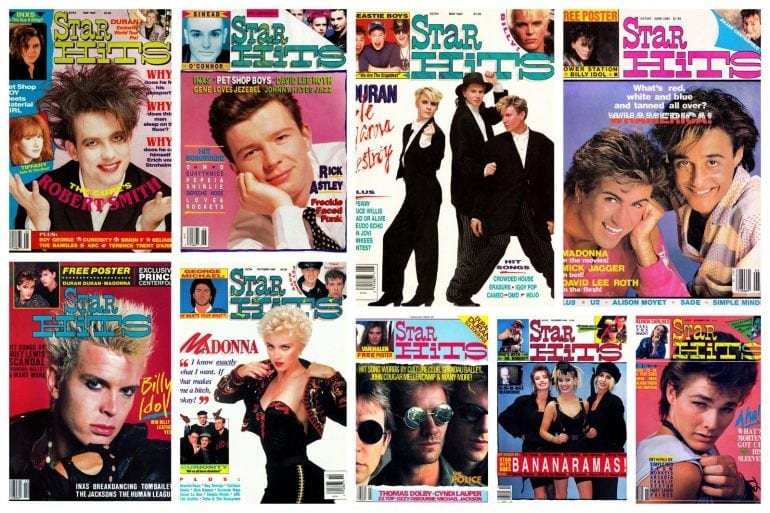
our room with Star Hits tear-outs of Duran Duran, Howard Jones, and Culture Club. They
took the place of my Muppets poster and her small B&W cut-outs of Matt Dillon from the
Chicago newspapers’ weekend movies section. On our closet door hung a huge poster of
that blonded-up post-punk trio The Police, A’s favorite. We fought over this space—I
wanted it for an MJ poster featuring the King of Pop in white slacks and a yellow cardigan
and matching bowtie. When A didn’t relent, I took her stick deodorant and defaced Sting
and Co’s faces with it. As it turned out, deodorant scrapes right off poster paper (who
knew?) and for years I had to contend with falling asleep under the sexy-intellectual gaze
of The Police’s lead singer night after night. Subconsciously, I must have started seeking
that same gaze among the boys at my school. Because one night, when I was just turned 13,
it struck me while staring back into Sting’s eyes: with that blond spiky ‘do and those
cheekbones and muscles, he kinda sorta looked like that one tall guy at school. Metallica
guy. Craig.

It was too bad Craig was all wrong for me. As in cool, popular, and rebellious where I was
shy, self-conscious, and unknown. We had no classes together, nothing in common socially,
and I was sure he didn’t know I was alive. He said as much when someone squealed my
crush on him. “I don’t know who she is,” he said, according to the girls who told him. Later,
presumably after someone pointed me out to him, he told our one mutual friend, “She’s too
nice.” And I couldn’t decide which was worse—being invisible or being innocent.

Something had to change and that something had to be me. I wanted so badly for it to be
me.

The truth was my life had become overwhelmed by changes. After turning 13, I got my first
period, having already developed physically—breasts, hips, height, the works—beginning
around 10 or 11. My older siblings started getting married off. And most life-changing of
all, my grandmother had had a stroke and had come to live with us. She was given the
room I shared with A, and all our music mag pics were taken down and replaced with
pictures and statues of the Holy Family and various Catholic saints—Madonna for
madonnas, you might say. A moved into a room formerly occupied by one of our brothers,
and I moved into a tiny tandem room off hers, about the size of a large walk-in closet. After
school, I had to be home to help look after my grandmother with my siblings, as our
parents worked full-time.

There comes a time in every young girl’s life when she senses things aren’t under her
control, that there are rules she’s supposed to abide by that she didn’t make and
expectations she has to live up to that she can’t possibly meet and taboos she shouldn’t
break that she suspects wouldn’t even be on the radar if she were a boy. Most girls react to
this realization head-on, and many by trying to take control over the one thing that all
these rules and expectations and taboos seem to apply to—her body. I was no different. If I
couldn’t stop change from overwhelming my life and overtaking the space I’d tried to
carve out for myself, I could at least try and make it work for me.

So I lost weight. A lot. I did it my way and the textbook teen girl way—dancing for hours to
records in the basement after school and eating as little as a scoop of cottage cheese for
dinner and a milk carton for lunch every day. It was only the beginning.

After graduating junior high, I spent the summer getting ready for high school reflecting
on possibilities, on the dream of having a completely different look, a completely different
social life—really, any social life. Meanwhile, A was going away to college, giving me her
room and everything in it she left behind. Her last couple years of high school, she’d begun
replacing her music mags with fashion rags, bookmarking spreads of stylish women whose
looks she wanted to copy and elegant rooms whose décor she wanted to surround herself
in. She’d always had a fashionable touch that I lacked. Studying her leftover, well-thumbed
through copies of Vogue and Mademoiselle, I knew such transformation was hopeless for
me, even newly skinny as I was. I was too hungry for high fashion—hungry to be noticed,
to be loved, to stop being so invisible and innocent.

Who else could I turn for a role model but to Madonna, by now the queen of everything, not
just a pop star but a cultural tornado-exploding-supernova. I didn’t know if Craig liked her.
I mean, looking back, reminiscing on all his death metal tees, probably not. But I don’t
think it even occurred to me. The point is I liked her.

So freshman year of high school saw a new me—dressed in extra-small tank tops I
converted into ultra-short miniskirts (I’d pull the neck part over my hips and tuck the
straps in at the sides) and visible bra straps and, yes, even rosaries worn as necklaces. Did
Craig notice? Because I know my grandmother did. She complained about it to my mother,
who was either too distracted by her new role as caretaker to her mother to notice her
youngest child’s increasingly provocative attire or had raised enough kids by now to know
a phase when she saw one. The only thing my mother objected to was the rosaries. “Those
aren’t jewelry,” she informed me one morning as I was heading out of the house for the bus.
And like the good Catholic girl I still was underneath, I obeyed and put the rosaries back on
my grandmother’s bedstand where I’d borrowed them.

If Craig wasn’t impressed by my new look, maybe a good old-fashioned note would do the
trick. But what to say to a pot-smoking, Slayer-loving, teenage Sting look-alike on the
football team who I’d been obsessing about for a year now? I didn’t trust my own words,
didn’t think I could put my schoolgirl feelings and hormonal yearnings into anything
eloquent enough to convince him of the urgency of my love and lust for him. That was
where music saved the day. I mean, he liked music. I liked music. What could go wrong?

After hitting on my epiphany, I spent a couple afternoons poring over all the songs in my
record collection, reading all the lyrics on the liner sleeves, trying to determine the perfect
song to snare Craig’s attention and devotion. At some point, I don’t know when—but I
wish I did, to better determine just what I was thinking—I settled on “Burning Up.” It was
from Madonna’s first album, same as “Holiday,” already an oldie in the wake of two more
albums she’d released. Unlike “Holiday,” it hadn’t been a hit, but in some ways it had
solidified Madonna’s hypersexual reputation more than any other song from her early
career. The most notorious of the lyrics went:

Do you wanna see me down on my knees?
Or bending over backwards, now would you be pleased?
Unlike the others I’d do anything
I’m not the same, I have no shame
I’m on fire!

Over time, serious music critics would suggest that the song’s love interest was really a
metaphor for fame or power. The video seems to back this up, showing Madonna writhing
around as if in sexual agony on a street intercut with some dude driving her way—until
the last shot sees Madonna behind the wheel of the car, sans dude and smiling.

Metaphor or no, I took the lyrics literal af (especially the line “But you don’t even know I’m
alive”), and diligently copied down the lyrics (where Madonna pants in the song, I
remember I wrote “heavy breathing”), and got a friend to pass off this surefire love tactic
to Craig in the hall one day. “This is from René,” I told her to say. “Cool, thanks,” Craig
reportedly said, shoving the note in his pocket.

I don’t know what I was expecting in return. A request for a date? A note with some
favorite lyrics of his own? To be taken seriously? I mean, really? It got back to me
eventually that Craig told our one mutual friend he started laughing when he read my
note—to his credit, he also told our friend not to tell me that. She did anyway, because she
thought I should know.

Regardless of whether Craig noticed me, others definitely had. I’d been frequently teased
by boys, but now girls were talking about me too, making fun of me, even the nice girls and
other misfit girls. And even before I’d lost weight, even before the new clothing choices,
around the time I’d begun gaining inches in height and curves, I’d started to get a certain
kind of attention. One boy at school would lift up my skirt as I walked down the hallways.
At the library I’d been followed into the stacks and groped by a man. These were just a
couple incidents I’d experienced. I didn’t know what to do when these things happened, other than run away and then blame myself for “leading guys on” or tell myself maybe I
should be flattered.

Looking back, I refuse to say I was confused. That I didn’t know what I was doing, like why
I’d picked an embarrassingly horny song to give to a boy and why I started dressing like a
girl in a music video, why I’d veered so far (so it seemed) from the innocent girl who just
wanted to dance her cares away in her bedroom on a Sunday morning. On the one hand, I
tell myself I compromised my true self for a boy’s attention, a ploy that didn’t even work.
On the other hand, I know I was trying to take control and ownership of the changes
overwhelming my life and the expectations and rules overwhelming any girl. I was trying
to take a cue from my name doppelganger—Madonna, the Michigan girl with an uncanny
ability for taking every rumor, criticism, or slut-shaming insult thrown her way and
wielding it to her advantage, to power.

Within another year or two, life would throw more changes my way. By 15, my father had
been hospitalized with a heart problem, my grandmother died, and I became an aunt for
the first time. As for Craig, I finally had a class with him and picked up on some crude
remarks he made, and some rumors that he’d hurt someone after school one day. I forgot
him. I started to put weight back on and dressing in loose, dark layers. Began reading
poetry and Irish and French history and listening to The Cure and New Order. I made pen
pals with a boy on the south side of Chicago who sent me rap lyrics and detailed his
graffiti-writing exploits to me. We started spending all night talking on the phone
together, when everyone else in our houses was asleep. I was depressed and curious and
artistic and still unconfident, but cared less whether people noticed, whether it was my job
to endlessly please the world as a girl was supposed to do.

There’s a temptation now to disown the girl I was at 13, to say “I don’t know her.” I’d do as
much with Madonna in the years to come, pretending I no longer liked her or her music,
denying to myself the leaps her best songs made my heart do and the moves her beats
once made my body do. But some things are just undeniable, like the person you were
when you were on your way to learning how to be yourself, or a girl’s desire to prove she’s
the one in control of her life, or an infectious song beckoning everyone to forget about the
bad times and put their troubles down, for just one day out of life. To this day, nothing does
it for me, nothing connects me to the better moments of my girlhood, like “Holiday.”

When I was in my 30s, I ran into Craig again, in a bar in Chicago. I was attending a book
swap event, and he was a bouncer, checking IDs as all us bookish grown-up former misfit
types entered the bar. We recognized each other right away, though he had to read my ID
to remember my name. He didn’t look like Sting so much anymore. And I didn’t even recall
the note I’d given him, or the girl I’d been, until thinking about my run-in with my old
crush later that night. Once the memory surfaced, the lusty lyrics to “Burning Up”
churning through my brain, I was mortified. And then I laughed, liked Craig himself did,
like Madonna after promising she was going to the rule the world on American Bandstand.

Bakery Girl

I wrote this creative nonfiction piece a couple years ago and sent it around to some lit mags but couldn’t get it placed. So I’m sharing it here.

This is dedicated to Roger, Mrs. C., Maria, Vladimir, and Mariann.

The longest relationship of my adult life has been with a local bakery: a Polish mom and pop in a Chicago suburb where I’ve been employed on and off since the early ‘90s, a few weeks before I turned 21. At the time I’d been working minimum wage jobs since high school, with no college degree and not much sense of where I belonged in life. But for fun I liked to bake cookies or whip up some fancy French toast the odd weekend, so I got it in my head to go to cooking school and become a chef or baker. Something like that. The local bakery seemed like a good place to start.

There’s a “sick burn” quote from the third edition of David Thomson’s A Biographical Dictionary of Film (1994) about movie goddess Michelle Pfeiffer: “She still carries the rather stunned, obedient air of an ex-checkout girl at the El Toro Vons supermarket.” Personally, I never noted such an “air” about Pfeiffer nor any of her screen incarnations, not even when she played a deglamorized diner waitress in Frankie and Johnny. But back in the ‘90s, when I was knee deep in mandatory hairnets and the impossible promise of guaranteed customer satisfaction, Thomson’s comment seared into my brain.

A film buff and bookworm, I spotted his book at the library, checked it out, and bulldozed through Thomson’s hundreds of acerbically funny and perceptive entries on Hollywood’s luminaries. Like the movies, Thomson’s wit was a welcome escape. But his entry on Pfeiffer unnerved me. Not because I was a fan of hers, but because it confirmed my fears that as far as the cultured people of the world are concerned, you can take the girl out of the working class but you can’t take the working class out of the girl. Or, in the case of any woman who’s worked a service job, that “smile and say ‘Have a nice day’ or you’re fired” reek of subservience. I mean, if the stunning — not “stunned” — Michelle Pfeiffer couldn’t convince someone she was born for better things than bagging groceries, even with all the transformative power of Hollywood’s dream factory backing her, what chance had someone like me, a Midwestern bakery girl of no special talents, looks, or connections?

Bakery girl. When I started cooking school (really, an associate’s in culinary arts program at a community college), I may have aspired to the title of chef or baker, but my domain at the bakery was always the store, not the bake shop in the back. And my title was “store girl.” That’s what the owners called all of us who set up the store starting 5 a.m., sliced and bagged the bread, boxed the donuts, weighed the butter cookies, stocked the shelves, rang up the purchases, made the coffee, carried out the cakes, answered the phones, took orders, wiped down the counters and tables, and swept and scraped (the latter on our hands and knees) the store floors before closing every night.

Store girl. Never mind that our ages ranged from 15 to early 70s.

There were no store boys, not in the 1990s. All the males worked in the back, meaning they did all the baking (and dishwashing and wholesale delivering). It sort of made sense, given all the heavy lifting and industrial equipment involved. The huge mixers, the lead-like buckets filled with custard and buttercream icing, and a wide-mouthed, revolving, floor-to-ceiling oven that warned away kitchen newbies with its perpetual fiery glow. It was heavy-duty baking, and heavy-duty baking apparently was no job for a girl. The only back of the house jobs any women did were packaging for wholesale, strawberry hulling (an endless job, fresh strawberries being the most popular choice of cake filling), and cake and pastry decorating.

The crew in the back wore bakery whites and heavy black shoes. We store girls wore a pink and beige smock with a matching hair scarf, white pants, and white thick-soled sneakers. The touch of pink was vital, underlining the distinction between us girls and the macho bakeshop crew.

We barely ever sat down — even on break, when there was a long enough lull to take one. My first day I brought a novel with me to read, imagining there’d be an official breakroom, like at the library job I’d had when I was 18, or somewhere private, like the popcorn room at the movie theater job I’d had when I was 17. But at the bakery there was no breakroom. Just a side room where baking tins and racks of fresh butter cookies were kept, plus some empty buckets you could pull out for a few minutes’ rest and a quick cup of coffee or instant soup. Never a donut though. You got sick of them fast. “I could never work here. I’d eat everything and gain a hundred pounds,” customers were always telling us. They didn’t seem to consider the concept of too much of a good thing, that even the smell of so much sweetness day after day put you off it all by the end of your first week.

Image for post
Old school bakery with bakery girl wearing uniform. Photo by DESIGNECOLOGIST on Unsplash

Not long after I started I changed my goal from baker to cake decorator. Partly because it was the decorators who impressed me the most. They were like wizards — creative, inventive, fast. They made it look so easy. Carving geometric shapes, faces, and household objects out of soft blocks of cake, squirting elegant calligraphy out of parchment pastry bags, molding the tiniest, most detailed features out of marzipan and rolled fondant, blending colors and fruits and flavors like alchemists mixing elements to make gold. And they were almost all women.

In his book Kitchen Confidential, Anthony Bourdain expressed his admiration for “studly women” who could “hang tough” in the high-testosterone world of professional kitchens. When the book came out, I had friends in the industry recommend it. By then I was a couple years away from the bakery, finishing up a bachelor’s degree in English at a state university and working in a mall department store. I’d applied for both, the mall job and college, telling myself I was done with food service work — and hopefully, soon, service jobs of any kind. I thought I might want to teach. Or work in an office. Somewhere I could sit down, somewhere I wouldn’t have to wear a name tag, somewhere I could nurture the bookish side of me I’d been hiding for off-hours, somewhere my confidence could grow.

But out of curiosity I tried a couple chapters of Bourdain’s book. His macho tone turned me off, his implication that women don’t belong in the restaurant industry unless they act like men.

It would be years before I’d see in Bourdain what others idolized. Like the way he championed food service people whether they worked at a famous five-star restaurant or a Waffle House. And Bourdain, to his credit, eventually owned up to some of the problematic elements of his first book, writing an essay near the end of his life expressing regret for the machismo he’d once (perhaps unwittingly) celebrated, finally calling out food service sexism for what it is: “meathead culture.”

Bourdain didn’t lie. In the service industry jobs I’ve had over the years, this culture took the form of male co-workers who’d freely talk about “the price of hookers” and joke about the smell of female genitalia in earshot of women workers. There were guys who wouldn’t allow a female co-worker to do anything that required too much physical exertion — they meant well but their thinking was that all women were weak. And there were guys who’d ignore you if you did ask for help — their thinking being that you wanted to work in this job didn’t you, so do it yourself like a man supposedly would. Then there was the young, hot-shot and hot-headed chef I worked with who once threatened “She’s in danger of becoming a battered woman someday” about a teenage waitress he said asked too many questions, was too mouthy. (Later he said he was just joking. Hahaha.)

This was just the back of the house sexism. Out front there were male customers who’d hound you for your number or stalk you by waiting for your table or turn at the counter or calling the store or restaurant, convinced your friendly customer service was really flirting. Which was probably the worst part of the job, much more than being on your feet all day or scraping up crumbs. You had to smile through it all. Even while being leered at by a man “just reading” the name tag on your breast. Or being called “sweetie” by a well-manicured woman pretending you have no name at all.

Machismo is only one flavor of sexism, only one style of disrespect. Women, in their own way, can be just as guilty. From the young, self-described “foodie” bride-to-be who left a thousand-word bad review of the bakery on every online ratings site because her wedding cake samples came in plastic cups, to the middle-aged professional who threw a fudge-iced éclair at a store girl because she didn’t like the way it’d been handed to her. (The iced side hit my co-worker right below her collar, just above her name tag, leaving an oblong-shaped brown spot the rest of her shift. After getting the manager to fill the rest of her order, the customer walked over to the store girl on her way out the door and jeered, “Have a nice day, hon.”)

Or maybe rude customer behavior has nothing to do with sexism. Maybe there’s another ism to blame — classism, capitalism, narcissism. Or maybe some people have impossible expectations. Maybe some people are just jerks.

Maybe Bourdain, while wrong, was also right.

Deep down, Kitchen Confidential riled me because I’d come to believe I wasn’t cut out for professional kitchen work. I was too intimidated to a fault. I didn’t have the cockiness or confidence for chef’s work, baker’s work, industry work. I didn’t know how to hang tough. I was a store girl, extra, out of her element.

David Thomson and Anthony Bourdain exposed a truth, or at least a perception, about women like me that hurt to face up to, much less confront. When I went back to school, it was in a core lit class that I finally saw some representation of the life I’d known, the same life I was trying to get away from, but this time it was cloaked in comfort.

In an American lit course we were assigned a Raymond Carver story, “A Small, Good Thing.” The story is about a middle-class couple whose young son dies on his birthday after a hit-and-run incident. Bookending the story, however, are two visits to a bakery. In the first visit, the mother orders a cake for her son’s birthday. In the second visit, the couple go to finally pick up the cake, three days late. Actually, they go to confront the baker, who’s been prank calling them about the forgotten cake over the three agonizing days since the boy was hit by the car and left lingering in a coma. The story ends with the baker hearing about the child’s death, apologizing for his cruelty, offering stories about the supposed lonely life of a baker, and feeding the couple some of his freshly baked rolls. “You have to eat and keep going,” he tells them. “Eating is a small, good thing in a time like this.”

I liked a lot of the stories I was assigned in my lit classes, but this one I actually appreciated. I read it more than once — not for study purposes, but to decide what I really thought about it, how authentic it was based on my experience. I couldn’t wait to talk about it in class.

I remember wanting to talk about some of the more contrived aspects of the story. Like why didn’t the baker, someone who’d clearly been in the business awhile, make the mother pay for the cake upfront, at least put down a deposit? Like we did at the Polish bakery. And why didn’t he just mention the cake in any of his phone calls to the couple? Or just say, “This is the bakery calling.” Again, like we store girls did at the end of the day with any orders still waiting pick-up.

But we never got to the story in class discussion. I never got to talk about it with anyone. It just became one of those stories of the American canon that I was supposed to file away and make sense of — its perfection, its meaning, its influence — on my own, like an interrupted dream or a lost ambition.

I decided it was good. What I liked was how dynamic the baker character is, how much he becomes the emotional heart of the story, evolving from the unyielding front he shows the mother at the story’s beginning, to cruelty and self-pity in its middle, to remorse and compassion by the end. To giving.

I decided his prank calling of the couple, unlikely in real life, was his assertion of his own value, of his worth as a worker and human being. He took the time to take this woman’s order, to make the cake just like she wanted, to put in the time and labor for a family he didn’t know and a child not his own. Never mind his “I’m just a baker” apology to the couple. He’s the only character in the story with something to offer the mourning parents beyond condolences or platitudes, something they can hold in their hands, smell and eat, nourish and comfort themselves with. Even their son’s doctors couldn’t give as much.

So Carver’s baker isn’t, in my experience, a perfect, authentic representation of bakery life. Maybe nothing is other than the life itself. But in terms of working-class respect, Carver’s story certainly beats Thomson’s quip. Carver himself grew up working-class, his father a millworker, his mother a sometime waitress and retail clerk. She could’ve been a woman I worked with. She could’ve been me.

(This past year of pandemic, like people the world over I’ve had a lot of sleepless nights. Nights of worrying and fear. Nights that lead your mind to the past, because the future is so uncertain. My mind would sometimes stray to cooking school, to my first days at the bakery, to Carver’s baker… Could I have been Mrs. Carver’s son? Or Bourdain, with more ambition and talent, more confidence and dark sorrow? How about the dead boy’s mother in “A Small, Good Thing”? What contrivances or curveballs would have to be written into a story or a life to make Carver’s lonely baker turn out a worldly legend like Bourdain? Or to make Bourdain turn out like Carver’s baker — lonesome but surviving, overlooked but still alive?

Or to make me a baker, any baker, instead of the girl who rings up the baker’s orders?

How about Michelle Pfeiffer? In the ’90s she seemed straight on the Oscar path. Decades later she’s yet to get there, nevermind her knockout looks or knockout performances. Was it something on her resumé? That supposed miscasting as the diner waitress in Frankie and Johnny? Or maybe the time she played, for real, a supermarket checkout girl. As Thomson said, maybe she played that role too well, too obediently. Unlike lonely bakers, who can find their way back to human connection, working girls can’t expect to live their common beginnings down, not without an enduring confidence or a long fight.)

Two things life teaches you is that plans barely ever pan out and rescues almost never lead you to the promised land.

After college I got the office job I thought would rescue me from service work for life. It was a bargain cookbook publishing job, and surprisingly, I was told they were more interested in my community college culinary arts degree than my brand new university B.A.

I didn’t adjust well. There were no windows in the part of the building where my cubicle was marooned. There were days when I had maybe ten minutes of work to occupy an 8-hour day. And it turned out offices have their own brand of hell situations to survive, from gossip and cliques to the farce of performance reviews, to back-stabbing. None of the working-class camaraderie I’d known in every service job I’d had, the got-your-back bonding that transcended even the sexism and male chauvinism when it came to surviving especially brutal busy days of churning out high-volume orders and facing throngs of customers.

There were nice breakrooms though, that was a plus. But also self-described “foodies” who’d hunt me down in those breakrooms. Offices, I learned, are filled with foodies. People who’ve never worked in a restaurant or professional kitchen a day in their life, but who watch lots of cooking shows, or read lots of gourmet magazines or restaurant reviews, or spend lots of time in the aisles of specialty grocery stores. Not that there’s anything wrong with all that. You wouldn’t be human if you didn’t enjoy the satisfaction of a good meal or the thrill of a cut-throat cook-off. But foodies are people who like to show off what they think they know. And the minute they hear you’ve worked in the industry or gone to cooking school, they want you to prove it. Which means, in the spirit of office passive-aggressiveness, they want to compete with you. Which means being hunted down anywhere in the office for recipe secrets or arcane ingredient advice or the low-down on local hot restaurants I couldn’t afford to eat in or chefs I didn’t know — then being challenged or negged on any experience or opinion you do share.

My first office job, I lasted less than a year before bolting for a full-time job in the deli and kitchen of a Whole Foods. It set a pattern for years to come. Ping-ponging between offices and kitchens, between jobs with health insurance and jobs with surprise health inspections, between higher-status “real jobs” and lower-status jobs that the world really can’t do without.

At some point, after a few years, I went back to visit the Polish bakery. It was during the Christmas season. I’d been working in publishing, but for not as much pay as I expected I’d be making back when I thought an office job was the answer. The bakery staff said they’d welcome any extra help to handle the holiday crowds. So I worked a few shifts, including Christmas Eve day.

It was just like old times, easy to get back in the groove of boxing donuts and slicing bread.

Yet things had changed. One of the brothers who owned the bakery had died. The other brother’s kids had grown up, were being groomed to take over. Prices had gone up. Almost no one wrote checks anymore — everything was put on debit cards. And all those cooking and baking shows that had flooded cable TV in recent years meant customers coming in with more elaborate orders, show-stopper cake designs, foodie-fed dreams of over-the-top sweet tables and multi-tiered cupcake trees and gourmet donut buffets. God knows what Carver’s baker would’ve made of such demands.

And there were store boys. Mostly high school kids. They wore paper caps and aprons. The store girls wore aprons now too. The pink long scrapped for maroon. The bakeshop foreman I’d known in the ‘90s was also long gone — he’d left to start his own business. There’d been a series of male, classically trained, high-end hotel pastry chefs who’d been chewed up and spit out by the bakery’s heavy-duty production rate. Now, in their place, was a Greek woman and a familiar face, one of the lady pastry wizards who had dazzled me back in the day. She wasn’t studly, she didn’t hang tough or make gross jokes about female anatomy. She was a mom and a new grandma.

Maybe seeing how a mom and pop bakery could change planted a seed in me that I could change too. That maybe class isn’t destiny — at the very least, not identity.

Working in cubicles, I did a lot of daydreaming. About being my own boss, maybe starting a business of my own. Back in the ’90s I used to work extra shifts to earn money to travel. In cooking school, I spent a few summers working abroad in Ireland in hotels and cafes. I hit on a travel business idea — specializing in group tours for women. I was thinking of women who didn’t feel like they fit in on family tours or couples tours. Or maybe women who just didn’t feel they fit in period and wanted to get away for a bit, to stretch their sense of adventure, to test their confidence. I intended to turn my back on office life and the rescue and dream that it never was forever.

As I researched the travel biz, became a certified tour manager, set up a business and website, started organizing tours, all along the bakery was there for me. Three years on, when the business failed, the bakery was still there. I felt like a failure, again, but my bakery colleagues waved that off. “You tried,” the store girls said, without a trace of snark, as we stood at the counter folding boxes. “That took courage, starting a business,” one of the older women said.

There were more changes anyway — the kind that kept you from dwelling too much on failure even as they broke the bakery family’s heart piece by piece. One of the wizard decorators, who started at 16 as a store girl, opened a competing bake shop. A fire burned down the restaurant next door and left us working out of a temporary facility for months. The matriarch of the family who owned the bakery died. A young man who worked in the back and a dear friend to all of us was murdered. And one November, two days before Thanksgiving, a longtime store manager said goodbye to us one night at closing: “OK, I’ll see you tomorrow, girls.” She never came back.

She’d been with the bakery since it opened doors in the 1970s. Truly, the original store girl. My first day, back when I was 20, she’d been the one to take me around the bakery and explain every single pastry to me, every flavor and filling, every shape of roll, every kind of bread.

That day before Thanksgiving, when she didn’t show up to work for the first time in decades, we still had to serve the crush of customers. We were stunned, obediently quiet to the news of death. But we store girls and store boys still had to smile, still had to say, “Have a happy Thanksgiving,” over and over and over again. We took turns going in the back to cry. So many of us had never known a Thanksgiving at the bakery without Mariann.

The crew in the back set up a buffet on one of the workbenches. Some had brought tacos. The owner roasted a turkey in the revolving oven. His daughter sliced a loaf of buttercrust white and one of seeded rye. Somebody added cans of cold pop, a bag of chips, salsa, a slab of butter, some butterflake rolls. Front of the house and back of the house took shifts eating from paper plates, standing up at the workbenches and back counters, sitting on empty buckets.

The bakery would be closed the next day for the holiday, but the store would be packed with customers ’til closing time, waiting for their pies and breads, waiting for us. They were counting on us. So we ate to keep going, to endure.
Selected Writings & Other Stuff

Some of my published work:

Nonfiction/Essays/Reporting

The Benefits of Taking a Writing Break (Lit Mag News)

Three new books expose the shameful history of Ireland’s Magdalene laundries (America)

Dream Paczki (Dunes Review, print only, apparently)

Is 50 Too Old to Become a Living Organ Donor? (Next Avenue)

The Tragic Testimony of the Daughters of Magdalene (Sojourners)

‘Derry Girls’ teen characters reach for peace, community and laughs (National Catholic Reporter)

What good is hell in the afterlife? Living through a global plague is hellish enough (National Catholic Reporter)

Bread Pudding for Dimitra Xidous (Poetry Potluck)

Island in the City (Substack) A (bi)monthly newsletter about outsider art, Chicago, creativity, oddballs, islands, and other interesting stuff

Bakery Girl (Medium)

Community cooks (U.S. Catholic)

Meet St. Gertrude, cat lady of the Catholic Church (U.S. Catholic)

How Chicago’s Graceland Cemetery Built a Prairie and Lost My Ancestors (Medium)

A pilgrim’s pace (U.S. Catholic)

Mixed Messages (Memoir Mixtapes)

Song recommendations (short memoir pieces) at Memoir Mixtapes:
White Mystery’s “Birthday”
Van Morrison’s “Purple Heather”
Kermit the Frog’s “Rainbow Connection”
Al Green’s “Belle”
The Gap Band’s “Party Train”

Maintaining Self-Esteem and Motivation in a Year of Rejection (Brevity blog)

The Unbeautiful Ones (Tiny Donkey) Editor’s Note; Tiny Donkey’s site has been taken down, so anything I published there I’ve republished on my site

Ancestral Hunger Pangs (Tiny Donkey) Editor’s Note

Modern-Day Mike Finks (Tiny Donkey) Editor’s Note

Writing Anxiety and the Wisdom of Improvisation (The Masters Review blog)

Lady Folk (Tiny Donkey: Brief Essays from Fairyland) 2nd-place winner in “Once Upon a Cartographer” contest

Dad’s Honor Flight: A Father’s Second Homecoming from the Korean War (Medium)

All Apocalypses, Bitter and Sweet (Literary Orphans) LO’s non-fiction Tavern Lantern site is no longer, so I’ve included the essay on my site here

New Mexico: Freedom on the Ground (We Said Go Travel)

Walking with the World on the Camino de Santiago (Encyclopaedia Britannica) Republished at Camino Ways

Women of Ireland (Encyclopaedia Britannica) More of my Britannica blog articles are available at this link

Walking to the Well (AranIsland.info)

Island Luck (AranIsland.info)

Writing and Wayfaring (personal travel blog)

Fiction:

The Widow’s Quilt (Medium)

Year of Conor McGregor (Hobart)

Bad Babysitter (Cease, Cows) Nominated for The Best Small Fictions 2018

The Guide to Good Apple Self-Care (Drunk Monkeys)

Chicago Rides For Michael Jackson (here, with author’s note)

Poetry:

Putting on Eyeliner with PTSD (Awakened Voices) Republished at Memoir Magazine

The Buffalo Return to Illinois (Rose Red Review) Another defunct journal, so I’ve republished poem on my site

Periphery (Thank You For Swallowing) Based on Edward Hopper’s 1939 painting New York Movie

The Subject and the Stranger (Ekphrastic: writing and art on art and writing)

Bioluminescent Bay, Aisling, and Coconut (The Writing Disorder)

Transference (Middle West) (Eunoia Review)

Golden Day (Literary Orphans)

The Fading of the Heart and Australia (Wilderness House Literary Review)

Interviews:

Interview with Jamie Kralovec, urban planner (U.S. Catholic)

Interview with Samantha Power, activist, author, and former U.S. ambassador to the U.N. (U.S. Catholic)

Interview with Louise Erdrich, novelist (U.S. Catholic)

Interview with Timothy Egan, journalist (U.S. Catholic)

Interview with Nuala Ní Dhomhnaill, poet (Tiny Donkey)

Interview with Kelly Vivanco, artist (Tiny Donkey)

Interview with Ram Devineni, filmmaker and comic book creator (Priya’s Shakti) (Tiny Donkey)

Reviews:

Once Upon a Time in Northern Ireland (National Catholic Reporter)

Derry Girls (National Catholic Reporter)

Ireland and the Magdalene Laundries by Justice for Magdalenes Research (National Catholic Reporter)

To Hell with It by Dinty Moore (National Catholic Reporter)

The Best Catholics in the World by Derek Scally (America magazine)

In the Event of Contact by Ethel Rohan (U.S. Catholic mag)

10 books young readers will love this Christmas (Christmas, Advent, and new children’s books roundup for winter 2020; U.S. Catholic mag)

Postcolonial Love Poem by Natalie Diaz (U.S. Catholic mag)

Lost, Found, Remembered by Lyra McKee (U.S. Catholic mag)

In The Field Between Us by Molly McCully Brown and Susannah Nevison (U.S. Catholic mag)

Book of the Little Axe by Lauren Francis-Sharma (U.S. Catholic mag)

Places I’ve Taken My Body by Molly McCully Brown (U.S. Catholic mag)

Other:

Encyclopaedia Britannica articles: Contributor of articles in Britannica’s core database on the topics of witching hour, Irish Travellers, Claddagh ring, urban legend, neo-noir, femme fatale, Midsummer, Mar-a-Lago, wendigo, nepotism, Oseberg ship and more.

The Dangerous Divide (Library Philosophy and Practice): This is an academic paper I published about how libraries are closing the gap in the digital divide for older adults, particularly during the COVID-19 pandemic when lack of access to the internet has had deadly consequences for this population. This was a final project for an MLIS course taught by Bill Crowley at Dominican University.

Tales of Old: A digital resource and annotated bibliography of representations of older women in folk and fairy tales. This was created for an MLIS course taught by Janice Del Negro at Dominican University.

Played the role of Marcy, the art school prof, in TV pilot The Artists

Photo: Coumeenole Beach, Ireland (Rockwell’s Camera Phone)

Photo: Untitled (Rockwell’s Camera Phone)

Forgotten Cookies

I wrote a short article for a religious mag about my mother’s old church cookbook collection. It’s also about trying to keep a sense of community and celebrate Christmas this year while so many of us are separated from our families due to the pandemic. You can read the article here (note: I didn’t write that headline).

I enjoyed writing this piece. It brought back some sorely needed fun memories.

I used to be in the business of cooking and cookbooks. After graduating from high school, I enrolled in a culinary arts program at a community college. Our textbooks were about 4 inches thick with technical instructions for working with and repairing industrial kitchen equipment and recipes that yielded much higher quantities than in the average coffee table cookbook.

After cooking school, I found a job as an assistant cookbook editor at a publishing company just outside Chicago. The cookbooks were the kind sold in catalogs or found in the bargain books section of chain bookstores. They relied heavily on brand name products, and there were all sorts of rules about which brand’s recipes could run on the same page with another’s and how to order the list of ingredients and what made a particular ingredient “index worthy.”

I remember attending photo sessions where a professional photographer and food stylist set up shots of perfectly sized cookies with just the right number of stray crumbs and an impossibly frothy glass of milk in the background. (The froth was created by mixing liquid soap into the milk.)

I remember other cookbook editor tricks like the time we came up short for recipes for a slow cooker cookbook (we didn’t have the licensing to use the term “Crock Pot”) that was supposed to feature recipes submitted by “real” home cooks across America. We resolved the problem by pulling recipes from our database and making up names to go with them using the editors’ pets’ first names combined with the married editors’ maiden names followed by some random town.

Out of the whole mix, we had to pick a winner from the recipes by actual home cooks and run a special “spotlight” with a picture of the winner in their home kitchen and a mini-interview. As this was my first publishing job, I wholeheartedly believed someone on staff had tested the recipes to choose the best one. My boss had to break it to me that what we picked was the recipe by the closest cook, not necessarily the best one. “What, you think it’s just a coincidence the winner lives in Gurnee?” she said.

Apart from my professional cookbook experience, I’ve worked off and on in a local family-run bakery going back to before my culinary arts degree days. A real old school kind of place. A lot of the cake and pastry decoration ideas came from Pinterest and Cake Boss, but the recipes were the genuine passed down from generation to generation variety. They were kept in a battered black book that was locked in a safe.

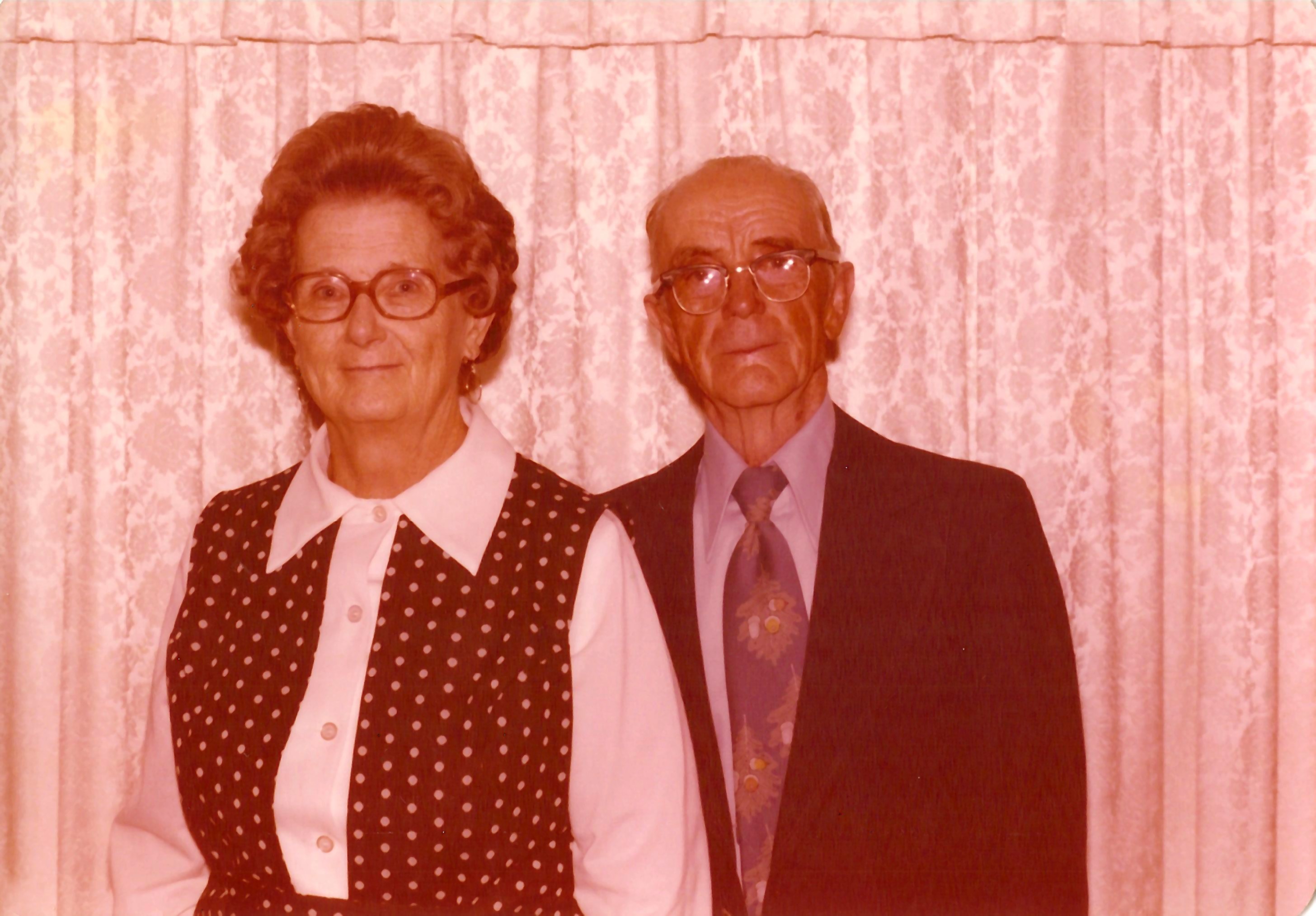
The best thing about writing this article though is that I got to name drop some of the parishes I grew up in as well as one of my beloved family members, my great-aunt Florence Fagan. Florence was my maternal grandfather’s sister. She lived all her life on a farm in Iowa. She and her husband, Francis, had four children: Ruth, a Franciscan sister in Dubuque; Marie, who has her own farm in Iowa; Joe, a former priest who founded the activist organization Iowa Citizens for Community in Des Moines; and Jean, a teacher New Orleans. Florence, Francis, Jean, and Joe have all passed away.

My great-aunt and great-uncle, Florence and Francis Fagan, of Iowa.

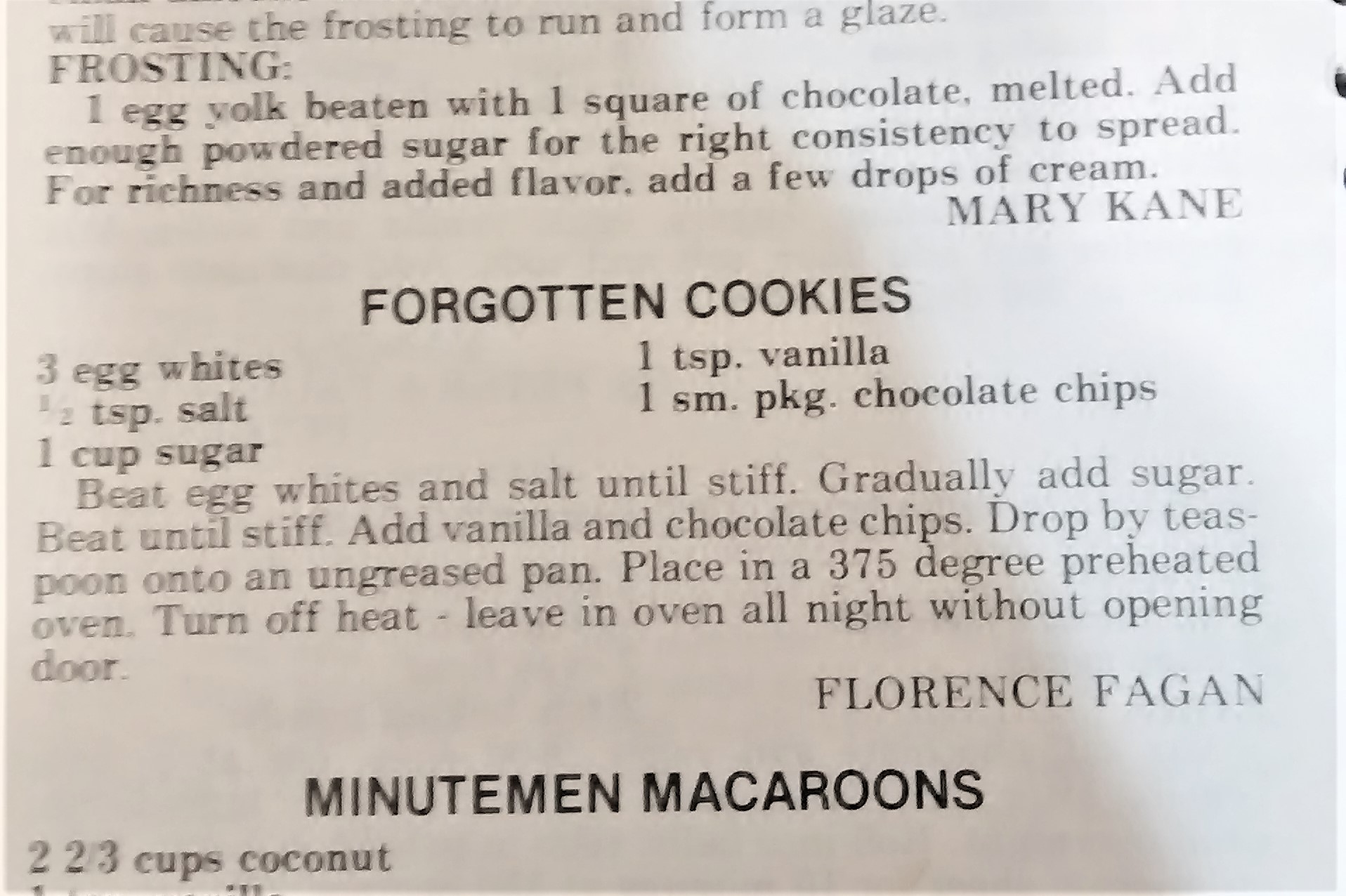
The New Melleray Abbey cookbook mentioned in the article has at least a dozen recipes by Florence–nearly all desserts. For the curious, here’s her “Forgotten Cookies” recipe in its original “parish cookbook” form:

Ancestral Hunger Pangs

This is the last editor’s note/essay I wrote for Tiny Donkey. As I wrote in a previous post, Tiny Donkey was a digital journal devoted to short nonfiction about fairy tales and folkore and associated with Fairy Tale Review. It was shut down in 2017, and its site was recently taken down from the internet completely. I’ve been rescuing all the essays and interviews I contributed here. This one was my favorite of all.


My mother’s kitchen cupboards are stocked with ancestral memories; crammed with what may look like ordinary jars and cans, boxes and bottles—but I know better. These are her hunger ghosts, I think to myself every time I open the cupboards, doppelgangers of old wounds and inherited hurts.

The same goes for the freezer and fridge, the fruit bowl, even the jar for cat treats. My mother hoards food. She consistently buys too much, as if she’s still cooking for a household of eight or preparing for a food shortage or a spell of famine. She overcooks too, long used to making large casseroles that needed to stretch into a couple days’ worth of leftovers. My father and I have tried talking to her, telling her to scale back, that we cannot possibly eat everything before it spoils and it’s a sin to waste food.

But I think she really is preparing for a famine, or reckoning with the haunting of one. My mother descends from the Famine Irish, the generation that left Ireland in the mid-19th century for their lives, escaping starvation and fever, mass death, and the devastation of centuries of British colonialism. Hunger is the reason she’s here, in America, and half the reason I’m here too, along with my brothers, sisters, and all my maternal cousins.

In Irish folk belief there’s a type of grass called an féar gortach, the hungry grass. Some say it’s a different shade than the green that famously carpets Ireland, more silver in color, or patchy and withered. Others say it looks like any other grass, and you only know you’ve stepped on it too late, when a great hunger suddenly comes upon you and nothing can cure it save a bite of some bread tucked away in your pockets (if you had the forethought) or a bit of your own shoelace (if you’re really stuck). It’s said hungry grass grows wherever a corpse has been laid down or someone has died. The belief predates An Gorta Mór of the 1840s, the Great Hunger. But an féar gortach took on a new, ghastly meaning then, in an era when famine victims were found in fields and on roadsides, a ring of green around their open, lifeless mouths after a last, desperate meal of grass.

As Ireland’s potato crop failed and its people starved, its other crops were harvested and exported by the shipload to serve on British dinner tables and fill British bellies. At least a million Irish died during the Famine, their bodies buried in mass graves wherever their lives gave out. In a sense, all Ireland’s green countryside turned to hungry grass, a landscape of want and loss, of lasting trauma and emptied beauty. At least another million emigrated, became refugees, exiles, Irish-Americans, Irish-Canadians, Irish-Australians, hyphenated people, diasporic, hungry.

Growing up, Mom spoke often of her family’s history, sang and played us Irish folk songs, explained to us the Famine, dressed us in green on St. Patrick’s Day. Maybe it seems a stretch to suggest my mother’s food compulsions have anything to do with an event in another country her ancestors left fadó fadó. But some events are simply too large, too traumatic not to eat into the blood, the DNA, the collective cultural memory of a people.

Mother’s ancestral memories transferred to all her children, but might have absorbed most deeply into me, her last-born child and the only one to go live in Ireland years later. I am the child who’s never married, never had children. Who’s struggled with her weight, eats when she’s not hungry, and bakes when she’s sad or simply bored. Who collects cats, books, and passport stamps like they’ll fill up some loss, some second-hand but deep-rooted want and need. The famished one, always looking for some patch of grass where the hunger finally makes sense.

Mom in Ireland, 1969.

The Unbeautiful Ones

As mentioned in a previous post, a digital literary journal that I contributed to and served as volunteer editor for a few years ago went the way of the dinosaurs recently. Tiny Donkey was an offshoot of the Fairy Tale Review and was dedicated to short non-fiction pieces about folklore and fairy tales. The journal shut down in 2017, but was still available to read online up until recently. With its site being gone, I’ve been sharing a few of my own pieces here.

This one is the third and last editor’s note I wrote for Tiny Donkey, about Hans Christian Andersen’s folk tale The Ugly Duckling. I loved the tale as a child, and I admit I identified with the poor créatur. I didn’t fit in as a child. At all. And adulthood has felt like a full-on flail as well. I suppose most people feel that way, more of us than each of us realize. In any case, I worried about appearing too emo or po-faced in this piece. Still, I hope anyone who reads it likes it, and I hope it did Andersen’s touching tale justice. And yes, I stole the title from a Prince song. You can’t tell me the guy who played The Kid in Purple Rain wouldn’t have related to The Ugly Duckling as well.


Growing up, you were shy. Or maybe you were short, you were fat, you had bad teeth. You had frizzy hair, you wet the bed, you spoke with a stammer. You slept with a stuffed toy ‘til you were twelve, or ‘til you were twenty, or ‘til your monthly blood ran out and you began soaking the bed with night sweats and hot flashes and Mississippi-wide rivers of regrets. You’re almost an old woman now. Love and transcendence have passed you by. Those fairy tales you were fed by Hollywood and MTV and Hans Christian Andersen as a child, and the ones you fed yourself to get by, through the loneliness of the school playground, through the long tick-tocking overthinking of the night, through the daily treacheries of life – they all lied.

Which fairy tale was it you always went back to, the one you believed in most? The one with the song saying someday your prince would come? Or the one where the funny-looking little duckling (you don’t like to say “ugly” – it’s a word that’s been used against you so many times) turns into a stunner of a swan? Did you think that might be you one day? Did you really? All along, you should have paid more attention to the crone, the ogre, the unredeemed outcasts, the ones haunting the margins, or worse yet, the ordinary ones, the unmagical, the unnamed and underappreciated. Because these were your destiny – not the beautiful ones, not the princess and the swan.

Or maybe the fairy tales didn’t lie. You just saw in them what you wanted, took what you needed. Beauty, hope, promises of happily ever after, some danger to make things interesting, some fear to cut through the dull of the everyday. You simply ignored the despair. Even though all fairy tales, and all life, is rife with it. Like that moment in Andersen’s tale about the duckling, when the bullied little bird welcomes the beauty of spring and a bevy of swans with pure, piercing heartache:

“I will fly to those royal birds,” he exclaimed, “and they will kill me, because I am so ugly, and dare to approach them; but it does not matter…”

Then he flew to the water, and swam towards the beautiful swans. The moment they espied the stranger, they rushed to meet him with outstretched wings.

“Kill me,” said the poor bird; and he bent his head down to the surface of the water, and awaited death.

In the next moment the duckling sees his reflection in the water, sees a swan looking back – his transformed self, his true tribe, his happily ever after. I wonder though, if the duckling had seen no change, no beauty, no swan staring back at him in the water, could he still have survived? Would he still have come to know happiness, belonging, self-love?

I need to know, same as every once and for-all-time misfit. Is there magic after all in despair? Can there be beauty in forsaken hope, transcendence without transformation, belonging when you’re the only one around to hear your own questions, a happy ending when the fairy tale, or life, or maybe yourself, is found so wanting?

Think back on the ones you paid too little attention to, while you were paying as little attention to the beauty in your worst and best self. The crone, the ogre, the marginal, the ordinary. The untransformed duckling. The resilient, the persisting, the interesting and astute, the ultimately self-accepting and wise. Lucky you – these were your destiny. The unbeautiful ones, who know how to make magic out of the most disappointing circumstances, to potion up an unbreakable spell of endurance out of yesterday’s cold pot of despair. Let them teach you to love whatever reflection stares back at you, to see the beauty in even a fantastically imperfect you.

Illustration by Johannes Larsen

Lady Folk

As mentioned in a previous post, I’m sharing pieces I wrote for a digital journal called Tiny Donkey, which was shut down in 2017 and whose site has more recently been taken down from the internet.

This is the first piece I wrote for Tiny Donkey, before I served as a volunteer editor. The journal hosted a “Once Upon a Cartographer” short essay contest, and this is what I submitted. It’s about two Irish women: Lady Gregory, the Anglo-Irish playwright, folklore collector, and cofounder (with Yeats et al) of the Abbey Theatre; and Biddy Early, the Irish-speaking purported witch/wise woman. This one 2nd place in the contest.

—–

Biddy Early peered down a bottle’s neck to see the future. One wonders if she ever saw Lady Gregory coming decades down the road, gossiping with Biddy’s old neighbors, collecting astonishing tales about this wise healer woman of western Ireland. Biddy Early was already legendary before she died—accused of witchcraft once, eternally at odds with the local priests, married four times over. She didn’t need Lady Gregory to make her famous-slash-infamous, or whatever the liminal space is where wise women dwell.

But Gregory needed Biddy. Her name lent authenticity to the cast of banshees, blacksmiths, and other characters in Gregory’s folklore collection Visions and Beliefs in the West of Ireland (1920). And her neighbors’ trusting chattiness about their own peasant practices and beliefs eased Gregory’s aristocratic guilt.

Both women were western Irish—Biddy born Bridget Connors in County Clare in 1798, Gregory born Isabella Augusta Persse in County Galway in 1852. Biddy was born the year of an uprising in Ireland against British rule—a fitting start for a figure of female rebellion. Gregory came into the world at the end of the Great Potato Famine, a time when 1 million Irish died by fever or starvation. She grew up only 25 miles from Biddy’s humble cottage, but she was a member of the gentry, an Anglo-Irish Protestant not only protected from the ravages of the Famine but a benefactor. The man she married, Sir William Gregory, was a member of Parliament with a Galway estate called Coole Park—a place of lakes, limestone, woods and wild swans. At the height of the Famine, Sir William drafted a clause in the Poor Relief Laws that led to the eviction of thousands of peasants in the west. These were among Ireland’s poorest population, the ones who suffered the Famine’s worst destitution, the most deaths. And the strongest bearers of the old Gaelic folkways and language. Biddy’s people. With their decimation, would Ireland’s folk culture follow?

Biddy survived the Famine, dying around 1872 with a priest’s blessing in exchange for breaking her magic bottle. Lady Gregory was widowed in 1892. Within a year she was immersing herself in the Irish language and folk culture and soon professing Irish nationalism. She sometimes paid her peasant storytellers small tokens for their memories—but never stopped collecting their rents.

Maybe Biddy’s chatty neighbors did trust Lady Gregory. Or maybe they were simply squaring another uneven exchange with a landholder—embellishing their barter by telling tall tales. Perhaps Biddy Early also managed to square an uneven barter. Maybe those glass shards beside the blessed deathbed belonged to a decoy bottle.


Ruins of Lady Gregory’s estate (Coole Park) in County Galway
Woods at Coole Park

Modern-Day Mike Finks

As mentioned in a previous post, a digital literary journal that I contributed to and served as volunteer editor for a few years ago has gone offline. It was called Tiny Donkey, and it was an offshoot of the Fairy Tale Review dedicated to very short non-fiction pieces about folklore and fairy tales. The journal shut down in 2017, but was still available to read online up until recently. With its disappearance went all the writing of its contributors, including some essays I wrote and commissioned and interviews with other writers and artists. I decided to share a few of my own pieces here over the next few weeks.

This one is the first editor’s note (but not essay) I wrote for Tiny Donkey, about the American pioneer folklore anti-hero Mike Fink. I wrote and published this literally days before the 2016 election that saw Trump rise to power.

As a personal note, I once got some feedback about this piece by someone who called it “weak.” Usually I welcome feedback or editing suggestions, but this was one time when I think the reader misunderstood the tone. It’s written in an intentionally understated, matter-of-fact tone, to match the speaking tone and verbal style of the people in the part of the country where Mike Fink lore comes from, for better or worse–Midwestern people, Mississippi River people, people like my family, like my many Iowa and Illinois relatives, and like me. So here it is: “Modern-Day Mike Finks.”

—-

Once I tried reading a 900-page book called A Treasury of American Folklore, by the folklorist B.A. Botkin. But I only got 60 pages in before dumping the “treasure” at a book swap.

It was the stories of Mike Fink that did it, a Mississippi River boatman of the post-American Revolution era celebrated for his outrageous boasts and pranks. His boasts were of the variety that he could “outrun, outjump, outshoot, outdrink, and lick any man in the country.” And his pranks? Well, he had a curious sense of fun, this Mike Fink, and a suspiciously specific kind of targets. Like the time he shot an African-American boy walking by in the heel just because he didn’t like its shape, and the time he shot the scalp-lock off a Cherokee man’s head for acting too proud, or the time he made his wife lie in a pile of leaves and set them on fire, letting her go just after her hair and clothes started burning, all for looking at another man.

Botkin labels Fink a “pseudo bad man” without explaining what that means. Along with many other folklorists who’ve written about Fink, he tries to assure us modern folks that Fink wasn’t real, or at least, his pranks weren’t. They couldn’t be, could they?

Though I’d never heard of Mike Fink before this, I don’t need any academic or historical investigation to know he was real. That he is real. I’ve known him. Maybe you have too. Maybe like me, you see him every day on the news, in life, in the memory of personal experience. Sometimes he wears a badge, sometimes a suit. Sometimes he’s followed me on the street or leered at me on the train. When I was young I sometimes encountered him on the playground or in the school hallway, trying to lift up my skirt or grab some part of me. More than once I’ve loved him and forgiven him. Sometimes he’s the picture of everything all good and charming. Oftentimes he’s put in charge of things, more than just riverboats, like committees, laws—and bodies, usually black, brown, and female.

I think now, this election year, he’s too close for comfort to being put in charge of the whole country.

I dumped that treasury of American folklore because I was too angry and ashamed to see what else was in the folk history of the United States, what further ugliness my country’s mythology had to reveal. The book confirmed what I’ve always known about my country, and my place as a woman in it, but don’t often like to face. I can’t afford to ignore the truth and cost of such “treasure” anymore. Mike Fink is deserving of dumping. America needs the coinage of a new, transformative folklore.

Selected Writings

A selection of my published pieces…

Nonfiction:

How St. Gertrude of Nivelles became the cat lady of the Catholic Church (U.S. Catholic)

How Chicago’s Graceland Cemetery Built a Prairie and Lost My Ancestors (Medium)

A pilgrim’s pace (or How I found healing on the Camino de Santiago) (U.S. Catholic)

Mixed Messages (Memoir Mixtapes)

Song recommendations (short memoir pieces) at Memoir Mixtapes:
White Mystery’s “Birthday”
Van Morrison’s “Purple Heather”
Kermit the Frog’s “Rainbow Connection”
Al Green’s “Belle”
The Gap Band’s “Party Train”

Maintaining Self-Esteem and Motivation in a Year of Rejection (Brevity blog)

The Unbeautiful Ones (Tiny Donkey) Editor’s Note

Ancestral Hunger Pangs (Tiny Donkey) Editor’s Note

Modern-Day Mike Finks (Tiny Donkey) Editor’s Note

Writing Anxiety and the Wisdom of Improvisation (The Masters Review blog)

Lady Folk (Tiny Donkey: Brief Essays from Fairyland) 2nd-place winner in “Once Upon a  Cartographer” contest

Dad’s Honor Flight: A Father’s Second Homecoming from the Korean War (Medium)

All Apocalypses, Bitter and Sweet (Literary Orphans) LO’s Tavern Lantern site has been hacked; until it’s fixed, check out my masthead for link to this piece

New Mexico: Freedom on the Ground (We Said Go Travel)

Walking with the World on the Camino de Santiago (Encyclopaedia Britannica) Republished at Camino Ways

Women of Ireland (Encyclopaedia Britannica) More of my Britannica blog articles are available at this link.

Walking to the Well (AranIsland.info)

Island Luck (AranIsland.info) Since their blog seems to be down these days, I’ve reposted this here.

Booma “Daily Spot” entries: These are short “bookmapping” pieces I contributed to Booma: The Bookmapping Project on the places mentioned in works by Carl Sandburg, Louise Erdrich, Toni Morrison, J.M. Synge, Frank O’Hara, and Wendell Berry. A lot of good stuff by a number of different educators and writers at this site — check it out.

Writing and Wayfaring (personal blog)

Fiction:

The Widow’s Quilt (Medium)

Year of Conor McGregor (Hobart)

Bad Babysitter (Cease, Cows) Nominated for The Best Small Fictions 2018

The Guide to Good Apple Self-Care (Drunk Monkeys)

Chicago Rides For Michael Jackson (here, with author’s note)

Poetry:

Putting on Eyeliner with PTSD (Awakened Voices) Republished at Memoir Magazine

The Buffalo Return to Illinois (Rose Red Review)

Periphery (Thank You For Swallowing) Based on Edward Hopper’s 1939 painting New York Movie

The Subject and the Stranger (Ekphrastic: writing and art on art and writing)

Bioluminescent Bay, Aisling, and Coconut(The Writing Disorder)

Transference (Middle West) (Eunoia Review)

Golden Day (Literary Orphans)

The Fading of the Heart and Australia (Wilderness House Literary Review)

Interviews:

Interview with Nuala Ní Dhomhnaill, poet (Tiny Donkey)

Interview with Kelly Vivanco, artist (Tiny Donkey)

Interview with Ram Devineni, filmmaker and comic book creator (Priya’s Shakti) (Tiny Donkey)

Other:

Editor at Tiny Donkey, October 2016-October 2017

Volunteer fiction/nonfiction submission reader for The Masters Review, January 2016-September 2016

Played the role of Marcy, the art school prof, in TV pilot “The Artists

Photo: Coumeenole Beach, Ireland (Rockwell’s Camera Phone)

Photo: Untitled (Rockwell’s Camera Phone)