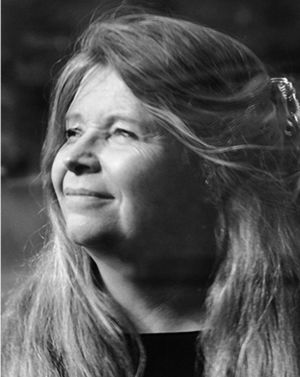
Interview with Nuala Ní Dhomhnaill

As mentioned in a previous post, I’m sharing pieces I contributed for a digital journal called Tiny Donkey, which was shut down in 2017 and whose site has more recently been taken down from the internet. Every month one of the editors interviewed some writer or artist related to folklore or fairy tales. I did this interview with the great Irish poet, Nuala Ní Dhomhnaill. It was a tremendous pleasure to get to correspond with her for this.


Nuala Ní Dhomhnaill is a poet who practices her craft exclusively in the Irish language. Born in 1952 in Lancashire, England to Irish parents, she was sent to Ireland at age 5 to live with relatives in the Gaeltacht of County Kerry, and later lived in County Tipperary. She studied English and Irish literature at University College Cork, where she met her future husband, the geologist Dogan Leflef. Her relationship with Leflef, a Turk and Muslim, was opposed by her Catholic parents, who made her a ward of the court and forbade her any contact with Leflef. In 1973 Ní Dhomhnaill left Ireland for Turkey to marry Leflef and start a family.

After 7 years abroad, she returned to the island and published her first collections of poetry, An Dealg Droighinn (“The Blackthorn Bramble,” 1981) and Féar Suaithinseach (“Marvellous Grass,” 1984). In 1986, she released Selected Poems: Rogha Dánta, featuring her Irish poems alongside English translations by Michael Hartnett. She has since published numerous Irish-language (Feis, “Festival,” 1991; Cead Aighnis, “Leave to Speak,” 1998) and dual-language editions (Pharaoh’s Daughter, 1990; The Astrakhan Cloak, 1992; and The Water Horse, 1999), along with plays, essays, and fiction. Her poems have been translated by Paul Muldoon, Medbh McGuckian, Seamus Heaney, Eiléan Ní Chuilleanáin, and many other contemporary Irish poets and in more than half a dozen languages. She has taught and lectured widely in Ireland, Turkey, Canada, the US, and Britain.

Apart from her choice to write in a minority language, Ní Dhomhnaill’s work is characterized by its focus on themes such as gender roles, language and culture, sexuality, and mythology. Her poems are abundant in imagery from both local Irish folklore and world-famous legends. Her recent dual-language collection The Fifty Minute Mermaid (2007, trans. Muldoon) is a powerful work that begins with three poems on authoritarianism before heading off into a long series of poems examining the habits and culture of Irish merfolk. The poems cover topics from mermaid hair-washing and breastfeeding, to the merfolk’s struggles with assimilation, family dysfunction, and religious abuse and hypocrisy. I contacted Ní Dhomhnaill to talk about this collection as well as her thoughts on language, culture, and mythology.

Your poems are so rich in images and characters from folklore, fairy tales, and mythology, it makes me wonder what role these genres play in your everyday life. Do you regularly read fairy tales or books about folklore and myth, or is your knowledge of folklore drawn from memory and stories you’ve heard? What inspires you to write a poem using fairy tale/mythical images?

I haven’t read a book of fairy or folktales in years—the last one probably Italian Folktales translated from many different Italian dialects by Italo Calvino, which came into the house in the early ‘80s and was fought over so much by my children Timuchin and Melissa that they tore it in two. (It was a very fat paperback, and they are notorious for falling apart.) I remember having to call down to them once “who has the half that has the introduction?” for something I was writing.

But there were no children’s books in the house when I was growing up so I tore through a set of books left from my grandfather—Myths and Legends of the World, a series of scholarly books from the beginning of the 20th century, and it answered a deep need in me.

It seems that the archetypal level of reality is much more alive in me than any other level. The same could be said of three of my four children, one of whom writes screenplays, and the other two, who have a real artistic bent. Recently I read that, what with all the neuroscanning, etc. they can do now, that they have found certain strict patterns of brain movements, which are really a physical proof of what Jung intuited as archetypes. I got an email recently from the poet Tom McCarthy, where he mentioned my “brilliantly symbolic life.” I had to laugh. About 10 years ago my father died. He was trodden to death by cattle, which is what you would associate with the Paleolithic rather than the 21st century AD. I happened to meet the writer Nuala O’Faolain on the corner of 2nd Ave and 5th Street in New York City shortly afterwards. I told her what had happened. Her response was “How is it, Nuala, that everything that happens to you has to be so mythological?” So there you have it. I think the mythological level is more active in me than any other, say, realistic, level. So it naturally expresses itself as archetypes, in poetry.

But what I really love to do is to go in to the Department of Irish Folklore in University College Dublin and read the stories in the manuscripts there. These give me a physical pleasure so strong, it is all I can do sometimes not to break into tears. This is the oral tradition at its best, what I heard the tail-end of when I was sent to Kerry from England at age 5. A richness of tradition cultivated by the works of thousands of scribes, who wrote down much of the medieval corpus in little copybooks, right up to the time of the Famine, mostly in Munster [province in the south of Ireland] and East Ulster [province in the north of Ireland], so that the oral tradition was enriched enormously. An example, I once spent an afternoon talking to a farmer, Mickey Long, as he dug up potatoes in the autumn. We were looking out over the expanse of Ventry harbour. He told me how, as a young boy in 1912, the whole British Atlantic fleet had come into the harbour and were at rest there. He told me the names of the flagships, the Indefatigable, the Defence, etc. He said he and his friends had rowed out to them and given them mackerel and got cigarettes in return. Then he used a phrase that translated means “the ships were so thick on the water that you could walk from the farthest out of them right into the shore without wetting your feet,” which I recognised at once as a line from the medieval text “The Battle of Ventry,” written in Regensburg in what is now Germany by an Irish monk in 1353. That kind of richness, that was kept alive for centuries, is what I absolutely exult in.

You’ve suggested in essays and other interviews that there’s a connection between expressing yourself in Irish and deeper emotional accessibility compared to writing or conversing in English. Can you talk about that? Is it the same for poetry, since you’ve written more poetry than you have any other form of writing? Do you find poetry a more accessible means for writing about emotions or about the mythical world than other kinds of writing?

I write poetry exclusively in Irish. I can only write poetry in Irish, as it seems to be where my emotions are located. I think rationally mostly in English, because most of the books, etc that I have around me are in English, but that only engages one part of my brain. Feelings come out in Irish. Imagination also. I luckily discovered this at a very young age, at 16, when in the middle of writing a poem in the study (instead of doing my French exercise) I suddenly realized that I was actually writing Irish prosody in English, and that was a stupid thing to be doing, why don’t I write it in Irish? Which I did, and I realized it was much better. The words seemed to sit more naturally on the emotions. I realized I was only a poet in Irish, not English. I never looked back. Irish, for better or worse, is the language of my emotions and imagination, and as I have said earlier, the imagino-emotional level is the most alive part of my psyche, so, ipso facto, it has to be in Irish. Mind you, I didn’t know any of this when I started out. It was by the very act of writing that all this became conscious.

I have written the odd short story in Irish also, which I am about to bring together this summer in a collection called after the longest story in the collection, “Sean-chathracha na hAise Bige,” which could be translated as “The Ancient Cities of Asia Minor.” I owe it to Bord na Leabhar Gaeilge [Irish Books Board], so I just have to finish it and clear the decks before I do anything else. My son is always at me to write a memoir, in English, so that the things that happened to me back in the early 1970s do not happen, even in a different form, to anyone else. I am collecting material for it, like going into the Wards of Court office etc, but I see it a few years down the road. In the meantime I am working on a new collection in Irish, Urú, which means an eclipse of both the grammatical and celestial kind.

Do you think there’s something that makes Irish unique in terms of storytelling about the Otherworld, the unseen and unproven, the subconscious or subliminal? Do you think this is an advantage or characteristic of minority languages in general or something special to Irish?

Well, in a post-religious, increasingly rational and empirical world, anything that keeps the imagino-emotional part of us alive, and allows it to function, is to be cherished and cultured. After all this is what makes us different from, and superior to, robots. Mind you, rationality has its time and place also. After all I was married to a very exact scientist for 40 years, and he was always pulling me up on my “woolly” thinking. And rightly so. I am a great believer in science and what it can discover and create, but it is not the whole picture. We are, rightly or wrongly, only occasionally rational animals. You only have to look at Brexit and the election of Trump to see that. And all the “hoo-ha” in Irish society about illegitimate children throughout the large part of the 20th century is another proof. Think of it, your daughter gets pregnant at 16. The rational reaction should be to be delighted, as it means you have a fertile daughter, and the next generation is accounted for. Instead you had this whole collective reaction of shame and the madness of locking poor young girls in penal institutions, often for their whole lives, and stigmatizing both them and their children ad infinitum. How logical or rational is that? If our emotional and imaginational levels are expressed freely, for instance through the arts, then maybe we can learn not to mix up things and have our emotions express themselves in all kinds of inappropriate manners. I have a very basic theory—that when Irish people switched language to English, their emotions were left behind in the Irish they refused to use or teach to their children. That is what my mermaid poems are all about. When you read the material in the manuscripts in the Department of Folklore, the sheer imaginative richness that pervaded people’s lives is astonishing. And because the medieval manuscript tradition was kept alive for so long, sometimes by ordinary farmhands, who copied them down into paper copies, at night, by the light of seal-oil tapers, Irish does have a long and very rich repertoire for discussing the non-rational and sometimes downright uncanny. I’m sure all languages do, Irish is not an exception. But minority languages, that haven’t undergone the rationalizing effects of Aristotelian schooling, have maybe an advantage.

The Fifty Minute Mermaid is my favorite collection of yours. It’s so sharp and complex in observation and emotion, and also so beautiful and evocative in imagery. Most of its poems are about mermaids and merfolk, and many of them are humorous, but there’s also an underlying sense of trauma throughout the collection. Of the merfolk suffering and surviving, and even inflicting, various forms of trauma. The title of the collection suggests the time of a typical therapy session. I’ve heard you speak about this collection and about Irish folk beliefs in general as a projection of the Irish people’s inner landscape, as the unconscious of the community. Can you talk about about that notion and how it affects your use of mythology and folklore in your work? Is there a relationship in your view between folklore or fairy tales and trauma?

I’m glad you like my mermaids, as a lot of people don’t seem to understand or appreciate them. Because they are not really mermaids, they are my birth family, with scales and gills attached. You see, in Ireland confessional poetry of the kind often written in America is really a no-go, as we are so hugely and deeply related to and networked with each other on this tiny island, and so madly curious about each other. So I take Emily Dickinson’s dictum to heart: “Tell the whole truth, but tell it slant.” Also by changing everyone into merfolk, I can perhaps reach at a truth that goes deeper than just something depending on the significant details of my own life. This is what poetry has always done for me. In doing so, it has helped me from going mad.

Only now, as I recover from my husband’s death, do I realize that a lot of this madness is still within and around me, and that only by writing can I still keep myself sane. And the folklore material, which I am convinced is a projection outwards of our collective paysage intérieure, is the perfect “objective correlative.” To express many things. Including trauma.

Many of your poems feature islands, either specific ones like the Blaskets (or Ireland of course) or unnamed, mythical islands. Is there a place or landscape you find more inspiring to write about? Where do you most like to write?

The fact that many of my poems feature islands, well, that has of course a lot to do to the place I was exiled to at age 5. The parish of Ventry, with the Blaskets just around the corner, and a view out at sea to the Scellig Rocks (about to be made famous worldwide by their use as a background in the next Star Wars). I wrote a series of poems called “Imramm” when I was dreaming a lot of islands. I think, retrospectively, that it was about a part of my personality that had been cut off, like an island, and that was emerging from the subconscious and becoming part of my main personality. I find walking Ventry strand a marvellous aid to writing poems, or rather getting the main action of the poem going. I finish it off then later, in the quiet shelter of my tiny little southwest-facing room in Dublin. And I mean tiny—six feet by eight feet. I am very loath to leave it, and will refuse to move anywhere else until I get a suitable substitute.

Do you have a favorite fairy tale or folk tale? If so, which one and why?

Yes, it is known in Irish as either “An Gadharaín Bán” (“The Little White Dog”) or “An Gabairin Bán” (“The Little White Goat”). There are a few versions of it in the Department of Folklore material. There is a version from Peig Sayers which I love, but my all-time favourite version is a version by Máire Ruiséal, also known as Cú an Tobair. Actually I found out that it is from a book of Norwegian stories translated into English sometime in the mid-19th century, where it is about a white bear. Of course, there are no bears in Ireland, so the story was naturalized as being about a different animal. P.J. Lynch has illustrated a version of it as East O’ the Sun and West O’ the Moon, which I managed to pick up one time for my kids in America. It is a modern version of the Amor and Psyche story and a wonderful girl’s quest story. It is interesting that it is the story picked by Éilís Ní Dhuibhne for inclusion in the women’s volumes of The Field Day Anthology of Irish Literature. The versions Peig and Máire tell are basically the same but the telling is so different—Peig’s is wonderfully baroque, with all sorts of curlicues and digressions, while Máire’s is very straight, with the wonderful interpolation to [story collector] Joe Daly, who was using the edeophone with her. “Bhi clann an ri amuigh ar an…a Joe, an féidir liom an focal Bearla a úsáid? The children of the king were playing out in the…Joe, can I use the English word? I can, alright then, Bhi clann an ri amuigh ar an bpiazza.

I also love the different versions that exist of “The Handless Maiden,” a version of which I used as the introduction to my first book, An Dealg Droighinn. The dealg droighinn is the equivalent of the blackthorn thorn that the maiden has to pull out of her brother’s leg, even though he has cut off her hands. I intuitively knew that that was the story of my life. Also, the various versions of the [fairy tale about the] man who unwittingly sells his daughter to the devil, including the well-known one of “Beauty and the Beast.”

There are a whole lot of them but somehow I don’t need them as absolutely totally as I used to. I’ve worked out a lot of my obsessions in my poetry, and so they no longer come back to haunt me.
Selected Writings

A selection of my published pieces…

Nonfiction:

How St. Gertrude of Nivelles became the cat lady of the Catholic Church (U.S. Catholic)

How Chicago’s Graceland Cemetery Built a Prairie and Lost My Ancestors (Medium)

A pilgrim’s pace (or How I found healing on the Camino de Santiago) (U.S. Catholic)

Mixed Messages (Memoir Mixtapes)

Song recommendations (short memoir pieces) at Memoir Mixtapes:
White Mystery’s “Birthday”
Van Morrison’s “Purple Heather”
Kermit the Frog’s “Rainbow Connection”
Al Green’s “Belle”
The Gap Band’s “Party Train”

Maintaining Self-Esteem and Motivation in a Year of Rejection (Brevity blog)

The Unbeautiful Ones (Tiny Donkey) Editor’s Note

Ancestral Hunger Pangs (Tiny Donkey) Editor’s Note

Modern-Day Mike Finks (Tiny Donkey) Editor’s Note

Writing Anxiety and the Wisdom of Improvisation (The Masters Review blog)

Lady Folk (Tiny Donkey: Brief Essays from Fairyland) 2nd-place winner in “Once Upon a  Cartographer” contest

Dad’s Honor Flight: A Father’s Second Homecoming from the Korean War (Medium)

All Apocalypses, Bitter and Sweet (Literary Orphans) LO’s Tavern Lantern site has been hacked; until it’s fixed, check out my masthead for link to this piece

New Mexico: Freedom on the Ground (We Said Go Travel)

Walking with the World on the Camino de Santiago (Encyclopaedia Britannica) Republished at Camino Ways

Women of Ireland (Encyclopaedia Britannica) More of my Britannica blog articles are available at this link.

Walking to the Well (AranIsland.info)

Island Luck (AranIsland.info) Since their blog seems to be down these days, I’ve reposted this here.

Booma “Daily Spot” entries: These are short “bookmapping” pieces I contributed to Booma: The Bookmapping Project on the places mentioned in works by Carl Sandburg, Louise Erdrich, Toni Morrison, J.M. Synge, Frank O’Hara, and Wendell Berry. A lot of good stuff by a number of different educators and writers at this site — check it out.

Writing and Wayfaring (personal blog)

Fiction:

The Widow’s Quilt (Medium)

Year of Conor McGregor (Hobart)

Bad Babysitter (Cease, Cows) Nominated for The Best Small Fictions 2018

The Guide to Good Apple Self-Care (Drunk Monkeys)

Chicago Rides For Michael Jackson (here, with author’s note)

Poetry:

Putting on Eyeliner with PTSD (Awakened Voices) Republished at Memoir Magazine

The Buffalo Return to Illinois (Rose Red Review)

Periphery (Thank You For Swallowing) Based on Edward Hopper’s 1939 painting New York Movie

The Subject and the Stranger (Ekphrastic: writing and art on art and writing)

Bioluminescent Bay, Aisling, and Coconut(The Writing Disorder)

Transference (Middle West) (Eunoia Review)

Golden Day (Literary Orphans)

The Fading of the Heart and Australia (Wilderness House Literary Review)

Interviews:

Interview with Nuala Ní Dhomhnaill, poet (Tiny Donkey)

Interview with Kelly Vivanco, artist (Tiny Donkey)

Interview with Ram Devineni, filmmaker and comic book creator (Priya’s Shakti) (Tiny Donkey)

Other:

Editor at Tiny Donkey, October 2016-October 2017

Volunteer fiction/nonfiction submission reader for The Masters Review, January 2016-September 2016

Played the role of Marcy, the art school prof, in TV pilot “The Artists

Photo: Coumeenole Beach, Ireland (Rockwell’s Camera Phone)

Photo: Untitled (Rockwell’s Camera Phone)

All Apocalypses, Bitter and Sweet

This nonfiction piece was originally published at Literary Orphans on Easter 2014, as part of the journal’s Irish-themed “Jonathan Swift” issue. Earlier this year though, the Literary Orphans website was hacked and wiped, including its nonfiction Tavern Lantern channel, where this piece was posted. The journal editors are still working on restoring the Tavern Lantern site. Until then, I’m sharing my essay here, because of all the pieces I’ve published so far, this is the one I’m most proud of, and I want people to be able to read it.

022 (2)

I

A woman who keeps bees is a woman I’d like to know. I think she’d be able to tell me a lot about the secrets of surviving this world. For starters, how to disregard the stings and cultivate the sweetness of life. I wouldn’t mind also taking a few lessons from the bees themselves. But we speak different languages, the bees and I. You might say we travel in different circles. They dance through air, I tread on earth. Their lives are short, sweet, and purposeful. They enjoy a profound intimacy with the world’s great beauties, the flowers.

Me? I’m 40 years here on earth—living, stumbling, bumbling, mistaking, basically wasting time. Intimacy of any kind is hard to come by, much less turn into something fruitful. The same goes with resolve. And effort. Between you and me and the bees, there are times when I’d rather stick my hand into a hornet’s nest than risk a flight at trust or hope or gumption, and a flight away from bitterness and fear.

A beekeeper is someone I’d bet on to have good advice and answers. But I’ve never known one to ask. The closest I’ve come to even meeting one was in visiting the alleged church of an alleged beekeeping saint who allegedly lived on an island off the west coast of Ireland long ago. This rumor of a holy hive-keeping woman is all I have to guide me.

II

Her name was Gobnait. A uniquely Irish name. To American ears, like mine, its pronunciation sounds something like what you might shout upon being stung by an insect. So of course a woman with a name like that kept bees. And it was the kind of thing holy people did back then, in the 6th century, when Gobnait had her turn on earth. In those days in Ireland, holy people were all around, almost as common as bees themselves. A land of saints, as they say. Some of those holy folks lived like honey bees, clustered together in communities of hundreds or more. Some were more like the bumble variety, settling with only a dozen or so kindred spirits. And some, like the carpenter bee, were solitary—self-marooned on lonely little rock islands or hidden away in dark and dinky caves.

Gobnait was something of a hybrid of all holy varieties, depending on where she was at in her life and on earth. On Inis Oírr, the western Irish island where Gobnait’s story first gets going, the locals say she arrived there from County Clare, just a few miles across Galway Bay, to escape an enemy or a family squabble. Who her enemy might have been, what the problem was, what sort of punishment or consequences she was running from, and whether she was ever found or followed by her pursuers—nobody knows. Not a word more about Gobnait’s life pre-flight has survived. If there ever was more to the story of Gobnait’s escape to Inis Oírr, those details have vanished or fallen away, like the features on a face carved out of stone many centuries ago.

Maybe Gobnait was already religious before leaving home. Or maybe it was her desperate dash across the bay that made her so. Maybe religious devotion was a comfort she conjured after living out on Inis Oírr—a small and thoroughly stony place, almost totally treeless and therefore shadeless, and in times of harsh weather, rather merciless. If this was where she started keeping bees, you couldn’t blame her for wanting to bring some sweetness to the surrounding bleakness. But as with her life in Clare, no one really knows what Gobnait did with herself on Inis Oírr, or even how long she stayed there. All the islanders can say is that she stayed until an angel appeared to her in a dream and told her to move on. This island was not the place for her. She was to seek out a place where there were nine white deer grazing. There and then she would find the place of her resurrection.

You don’t argue with angels. Not when there’s a heavenly reward, on earth or otherwise, at stake. Gobnait went back to the mainland so, where she wandered the country for a while, keeping her eye out for the nine white deer and the place of her true belonging. The story goes that she stopped in Kerry and Waterford and Cork, giving her name to a church here, a village there, like a child dropping crumbs or clues just in case she lost her way. Or perhaps in case anyone was looking for her. Was anyone looking for her? Wouldn’t there have been? No one seems to ask in the Gobnait story. The point has always been what she was looking for. And where she found it.

Gobnait’s reward of resurrection actually came in increments, in teases, like a dancer dropping the veils covering her body and revealing herself one inch of skin at a time. She found three deer first, in Clondrohid in County Cork. Then a herd of six at Ballymakeera, a few miles roughly northwest. Then finally nine after crossing into a village called Ballyvourney over the River Sullane. There she stayed, built a convent, and made a reputation for herself as a healer who had a way with the bees and a holy woman capable of performing miracles. Among her miracles are the time she kept a plague away from Ballyvourney simply by drawing a line in the earth along the village’s eastern borders, and another occasion during which she caused some cattle thieves to flee by letting her bee friends loose from their hives. That latter miracle might seem obvious and ordinary enough—anyone can poke a stick into a few bees’ nests and rouse their fury after all—hence, no miracle at all. But Gobnait turned her army of bees into actual soldiers, you see, and for an extra dose of no-nonsense she hurled one of the hives at the fleeing thieves and made it change into a helmet as it flew through the air at the bolting crooks.

It can be hard to square such violence, such unapologetic vengeance, with the modern notion of what a saint should be. Saints are supposed to be nice. Mother Teresa smiling on the cover of a magazine nice. St. Francis of Assisi holding a kitten in someone’s backyard garden nice. Not necessarily without backbone, but not vindictive to the point of throwing potentially murderous heavy objects at people’s heads either. Even after taking into account old stereotypes about Irish tempers (and there are stories of other Irish saints, besides Gobnait, who also liked to throw things and start up a brawl every now and again), there’s something both extraordinary and extraordinarily admirable to me about Gobnait’s flashes of anger, something so correctly drawn about a woman once chased from her home now chasing away others, making lines in the earth, marking boundaries, protecting her turf, defending the place of her resurrection from thievery and greed and disease, from any chance of being spoiled or taken away from her, especially after it took such wandering for her to finally get here.

She had a right to be so territorial. For in the end Ballyvourney was indeed her place of resurrection. Her grave is there, near the traditional site of her convent, and near a holy well, a cemetery, and a statue of a rather downcast and dull-looking little woman wearing a long cape and rosary beads and standing on a stone hive. The statue was erected in 1950, a representation more of its time, of how Ireland once wanted its women to be—modest, devout, unchallenging—than of the territorial and spirited woman who guarded 6th-century Ballyvourney.

171 (2)

III

I have never been to Ballyvourney. That’s a bold confession on my part, as Ballyvourney is of course the go-to spot for Gobnait groupies and devotees. On her feast day, February 11th, locals and visitors make pilgrimage to Gobnait’s grave there. The day is marked with a turas, in which pilgrims visit designated stations at the monastic site, moving around them in a clockwise direction and saying the usual prayers—the Our Father, the Hail Mary, the Glory Be—as they go. There’s no re-creating of Gobnait’s more memorable life moments—no hive or helmet-throwing contests, no banishing of plagues, no running or wandering. Not as far as I know. Since I only know Gobnait-devotion through the place she ran from, not to—through Inis Oírr.

On Inis Oírr on Gobnait’s feast day, the islanders huddle inside the small, roofless, stone church dedicated to her for a special mass in her honor. It’s usually a small crowd, and mostly women. Very unlike the outdoor mass in June for Inis Oírr’s patron—and male—saint, Caomhán, held in a larger yet also roofless church in the island graveyard.

St. Caomhán’s church may just get more attention because of its obviousness. The graveyard in which it lies—and I do mean “in”—is on a high dune just off the beach and the island’s tiny airport. The church has long since sunk into the sand of the dune, and the islanders used to have to clear away the sand regularly until grass was planted around the church to keep the sand back a bit. Climbing up the dune to the cemetery and coming to the edge of the church ruins is like stumbling upon and looking down into the world’s largest and most worn-out treasure chest, its top ripped off and its contents emptied out with just sweepings of dust left in the remains of the frame. Despite the church’s deathly surroundings, it has an association with luck. There’s a belief that if you can fit through the very narrow open window above the church’s stone altar, you’re bound for heaven when you die. Near the church is a small house-like structure that protects Caomhán’s grave. The islanders say if you spend the night lying on it, especially on the eve of his feast day, you’ll be cured of all illness.

Gobnait’s church, on the other hand, is hard to find. It’s in a field among many fields that cover the island, all separated from each other by high, hand-built stone walls that give the island fields and roads a maze-like appearance from above. It’s easy to get lost looking for Gobnait’s church. Which may be what the runaway saint would have wanted. And even if you do find your way, there’s little luck to be won there. Beside the entrance to the field of Gobnait’s church are a well and a tree with a bad reputation. Now on an island as barren and rocky as Inis Oírr, you’d think a tree would be seen as a blessed thing, a miracle even. After all, you can count the number of trees on the island on one hand. But the tree by Gobnait’s church is an elder, one of several tree varieties in Ireland often associated with fairies and all the tricks and mischief fairies like to get up to. Worse, Gobnait’s tree is actually a twin elder, two trickster trees grown into one. Double the trouble.

As with Caomhán’s church site, there are graves at Gobnait’s church, or maybe they’re outdoor altars—no one can decide for sure. There are also the remains of a clochán, a very small stone hut that must have kept some sacred or solitary-loving soul on the island out of the rain long ago. It has no roof now, same as Gobnait’s and Caomhán’s churches. It’s almost as if there’s a moral to be found in all these roofless old structures on the island: Stick around this place long enough and you’ll lose your head. Just wait for it.

128 (2)

IV

Gobnait’s church site was my favorite place on Inis Oírr in the days I lived there. That was many years ago, but hardly as many as when Gobnait did. I came to the island from the opposite direction than Gobnait, from America, from Chicago. I wasn’t running or escaping anything—not yet. I was just looking to spend some time in a foreign country I had visited once before and wanted to get to know better. When I went to Ireland to live and work, I expected to end up in Dublin or Cork—in a city at any rate. I never dreamed I’d end up on a tiny island off the country’s west coast.

How I landed on Inis Oírr is a story for another time. If nobody knows how or why no less a figure than St. Gobnait got there, nobody really needs to know how or why I did. There was a job there on the island, in a hotel over the summer, when I went looking for one and couldn’t seem to find one anywhere else in Ireland. That’s really all there is to it.

Though I would spend the next three months living and working on Inis Oírr (and several more summers to come), it took me awhile to come across Gobnait’s church site. I don’t even recall if I found it the first summer I was there. But once I finally did, it became my favorite spot to get away from it all. (Yes, I know, as if being on a small island on the opposite side of the Atlantic wasn’t getting far enough away from it all to begin with.) There’s a low hill in the corner of the field of Gobnait’s church, and I liked to sit there and read or look out at the pieces of the sea and mainland and horizon you could see from the hill between all the island walls. Once in a while I’d go to Gobnait’s field and find someone else, some tourists or such, already there—taking pictures, inspecting the old church and graves, maybe resting on the hill themselves—and I’d feel jealous and frustrated. How to get rid of them? How to make them buzz off?  I never really tried. Despite my big-city background, I’m not a confrontational person. I’m Midwestern, and Midwesterners don’t make waves. We never learned, what with no ocean around us.

When I found someone else intruding on my favorite spot, I tended to just walk on. Maybe I’d come back after a while to see if the intruders were gone, but usually I’d just accept it and find somewhere else to read or watch or brood. The back of the island was usually a good bet. It’s entirely uninhabited—by people, at least—and wild. At the back of the island, the stone walls are mostly tumbled down and crumbled away, leaving messy hurdles of rock for walkers to climb over only to land on more rock—great, long, fissured blocks of limestone jutting out into the sea. There may be a couple islandmen around collecting seaweed for fertilizer if the tide is out, and there may be a few tourists who’ve found their way out here—but the sound of the sea generally drowns out their chatter and the clicks of their cameras and tends to humble them into either high-tailing it back to civilization at the front of the island or finding a cranny in the rocks to cower against, as sea and stone duke it out in the fight for elemental supremacy. This part of the island can make a scaredy-cat out of a street tough and a hermit out of an attention whore.

Gobnait picked a good place to run away to, is what you think while exploring Inis Oírr. Even if it wasn’t the end place for her, it was a good hideout, a good place to recover from whatever personal apocalypse drove her here to wait for news of resurrection.

35783150036

V

There are women I know on the island who refuse to believe the negative superstitions around Gobnait’s bad-luck double fairy tree. There are women on the island who in fact will go to Gobnait’s field to “sit with Gobnait” whenever they need time and space to think or reflect—they’ll go to Gobnait’s church over the modern church on the island or even Caomhán’s church any day. I myself never heard anything bad about Gobnait’s tree or field from the islandwomen. It was a man who told me. An islandman and a one-time sweetheart of mine.

Once while holding hands with this sweetheart and walking on the road past Gobnait’s church at night, I mentioned to him that it was my favorite spot on the island. “You know there’s a lot of superstition about that tree,” he said to me. “Lots of people here say they get a bad feeling passing it after dark. They say they don’t trust it.”

I didn’t have much to say in response to that then. I was, after all, a girl in love, young, quite inexperienced, and giddy with the romance of walking at night under a starry sky with one of the island’s handsomest men. All I had on my mind was the fire in my heart, not the cool tone in his voice. It was only two days later when he would betray me badly and break my heart.

Did the tree jinx us? Was it the double tree who double-crossed me? Or was it him? Or me? Something I said, or didn’t say, when my islandman and I passed the tree by? Perhaps there are cautions on the island against women who stand in spoken solidarity with trees. Reaching as that may sound, consider that one of the only other trees on the island had a stone beneath it dedicated to the mná na hÉireann, women of Ireland, in honor of a visit by Ireland’s first female president, Mary Robinson—and the stone was broken in half, replaced, and broken again. They say the “women’s tree” was eventually blown away entirely, in a storm. Maybe it blew all the way to Resurrectionville, Ireland, itself: Ballyvourney. Maybe it found refuge there, replanted itself, and grew to cast loving shade over Gobnait’s grave. Maybe it even shelters a beehive in its branches.

I dream up these notions of renewed life for a lost tree because I’m too proud and too bitter to dream up notions of renewed life for a lost love. After getting my heart broken, I became a running and wandering woman, same as Gobnait had been. But where she ran to Inis Oírr, I ran from it, and I wouldn’t return for years to come. Nor would I find my place of resurrection, despite hops around America to Australia to Bolivia to Mexico to France and Spain. And I never lent my name to any of the places I passed through, didn’t drop clues for anyone who may have been looking for me…though all along I wondered if someone might be, hoped that someone would be. I’ve also yet to come across any white deer—though other miracles, in other forms, have certainly been abundant. The most unexpected, most bitter and sweet, was seeing the face of the man who betrayed me, back in Ireland, over a decade on. He didn’t bring me resurrection. He brought a handshake. Likewise I didn’t bring forgiveness. I brought a hug. These things come in increments, in teases: one step, two steps, three steps…three deer, six deer, nine deer…a few inches of skin, a few inches of self-exposure, trust, and courage at a time.

VI

Gobnait was by all accounts a nun and a virgin, so she may have been innocent of the disasters of love affairs. Yet her legend begins with a running, a fleeing, the kind women do when disaster is fresh and raw as a still swelling sting. Any woman who’s ever been burned can understand the desire to give it all over to God, to scorn men for solitude or society for a nunnery, to trust no one but the bees. Every woman has her own Ballyvourney ahead of her, and behind her, her own Inis Oírr. Considering that in Gobnait’s time Ireland was swarming with saints (Wikipedia’s list of medieval saints numbers well over 100), one has to wonder how much of it came down to holiness and how much to heartbreak.

VII

Whatever their motive in the old days, holy people are a rare breed today. In Ireland, in America, perhaps everywhere, people just don’t get up and maroon themselves on an island or in a desert for the sake of the sacred anymore. Our times produce few saints. They’re almost extinct. And word is that the bees who once kept their company aren’t far behind.

It’s called colony collapse disorder, this large-scale vanishing of the bees, and it’s a red-hot topic. I could have written a whole essay here about it, written as many paragraphs as above examining all the reasons for what’s killing the bees off and the consequences for us humans and what we can do about it. I’m sure there are readers who would tell me I should have written about these things, who would tell me a personal heartbreak and the life of a long-gone holy woman are much less worthy topics of discussion in the grand scheme of things and, for further convincing, might toss off a quote that’s been going around lately (attributed to Einstein, though it’s never been verified) that says humans won’t last even half a decade if a beeless planet comes to pass. I admit this prospect is a much more pressing issue. I also admit I’m not so interested in the pressing issues.

There’s already a multitude of people shouting a multitude of questions and answers and opinions on the disappearance of bee colonies. They shout things like: Pesticides! Viruses! GMOs! Also: Climate change! Monoculture! Cell phones! Bee malnutrition! Indeed, the list of culprits gets longer as more bees disappear and more people take notice. Still, the shouting may not be loud enough, the message not yet focused enough or crystal-clear to cut through to people’s serious concern. Perhaps there’s still time for the shouters to prove themselves heroes and life-savers, or they may suffer the fate of tragically unheeded sages, of failed missionaries, of hoarse-voiced street preachers ranting and raving about the loss of faith and the coming end times.

I for one don’t doubt the urgency. I like bees. I dig their buzz. I don’t want to see them go away. I like honey, and I like all the fruits and nuts and such that bees pollinate for the world. But all the same, I’ll leave it to the know-it-alls of science, biology, and the environment to fight over the various reasons and solutions for colony collapse disorder. They can work on saving the world’s source of sweetness. I’ll work on resolving my personal store of bitterness. So I’d rather turn to that back-page place where women’s stories and women’s glories so often get buried. I’d rather investigate the mystery of a little-known female saint in a little country than the tragedy of something so large as a worldwide apocalypse.

Besides, St. Gobnait’s story is something like an apocalypse. For every life that’s ever sparked and ended is an apocalypse of sorts. So is every creation that’s ever crumbled or vanished or come to lose meaning and appreciation in time. Really, we’re all apocalypses—men, women, bees, bad-luck trees, holy people, hives, half-hidden churches on islands, and deer herds straight from a hermit woman’s dream. All runnings and vanishings are apocalypses as well. All arrivals, resurrections, and fumbles at forgiveness. All wishes, answers, shoutings, and conversions. All love affairs too…especially love affairs.

114 (2)

Selected Writings

A selection of my published pieces…

Poetry:

The Subject and the Stranger (Ekphrastic: writing and art on art and writing)

Bioluminescent Bay, Aisling, and Coconut  (The Writing Disorder)

Transference (Middle West) (Eunoia Review)

Golden Day (Literary Orphans)

The Fading of the Heart and Australia (Wilderness House Literary Review)

Fiction:

The Guide to Good Apple Self-Care (Drunk Monkeys)

Nonfiction:

Lady Folk forthcoming (Tiny Donkey: Brief Essays from Fairyland)

All Apocalypses, Bitter and Sweet (Literary Orphans)

New Mexico: Freedom on the Ground (We Said Go Travel)

Walking with the World on the Camino de Santiago (Encyclopaedia Britannica)

Women of Ireland (Encyclopaedia Britannica)

Louise Erdrich “Daily Spot” entry (Booma: The Bookmapping Project)

Frank O’Hara “Daily Spot” entry (Booma: The Bookmapping Project)

Walking to the Well (AranIsland.info)

Other:

Played the role of Marcy, the art school prof, in TV pilot “The Artists

A complete list of my credits can be found here. You can also follow me on Facebook.